Episode 30. Harry Price.
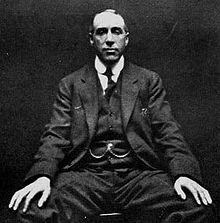
A photograph of Harry Price, taken by paranormal hoaxer William Hope in 1922.
Today’s blog is an introduction of sorts to a case that will follow on, focused on the Borley Rectory. Be sure to subscribe to make sure you catch the next case.
Today, we look at the controversial investigator who made the case famous.
Harry Price was born on January 17, 1881, in London. He was a fairly exceptional child, and at only 15 years old, he founded the Carlton Dramatic Society, for which he wrote plays about his experiences with poltergeists and the paranormal. He had had an interest in the supernatural from a very early age, and this would drive him further in his career, as well as shape his life and legacy. He would also come up against heavy, and often warranted, scrutiny throughout his careers.
In 1908, Price pursued archaeology while working as a salesman and writing for the West Sussex Gazette and Southern Weekly News. His discoveries of “clean antiques” were often questioned in terms of their authenticity. For example, his discovery of an ingot stamped around the time of the Roman Emperor Honorious, who ruled from the year 393 – 423 was queried. An expert in Roman history declared that the ingot was indeed a fake, determined by its shape and lettering, which had been altered to make the ingot appear genuine.
In 1920, discovering what would be a lifelong passion for conjuring, stage magic, and the paranormal, Price joined the Society for Psychical Research and in 1922, joined the Magic Circle. He would be involved in debunking multiple cases of fraudulent mediums having come to know various tricks of the trade by his involvement in stage magic and conjuring. Some of his more notable cases and movements in the spiritualist field follow:
In 1922 Price and his colleagues, James Seymour, Eric Dingwall and William Marriott exposed spirit photographer William Hope. Price had marked Hope’s photographic plates without his knowledge, having etched them with a logo that would transfer to any images produced with them. Hope went on to produce several photographs of spirits claiming to have used these plates, however, none of those photos developed with the logo of the plates that had been provided to him. It was through this that Price was able to conclude that Hope had been substituting his regular plates for others which would allow him to print upon them images of spirits.
In 1923 he exposed medium Jan Guzyk as faking events, stating that “man was clever, especially with his feet, which were almost as useful to him as his hands in producing phenomena.” in his book “Search for Truth: My Life for Psychical Research. It appeared that the medium had been using a very common trick in creating sounds and phenomena throughout his psychic readings using his feet. In 1925, he exposed Maria Silbert for the same. She would use her feet and toes to move objects during seances.
In 1926, Price formed the organisation the National Laboratory of Psychical Research as a rival to the Society for Psychical Research. The two organisations would butt heads over years, each disputing each other’s findings. Price claimed that he had been attacked and bullied by Arthur Conan Doyle, a spiritualist, and yes, the same famed author who created Sherlock Holmes, who was frustrated with the damage Price had done to the spiritualist society in publishing a pamphlet that exposed Hope as a fake. Price wrote that “Arthur Conan Doyle and his friends abused me for years for exposing Hope.” Doyle had threatened to have Price removed from his laboratory should he continue to write such, quote, “sewage”, about the spiritualist movement. In other notable names, Price was friends with Houdini, the great magician, who also worked to debunk or expose fraudulent mediums and therefore had similar tensions with Doyle.
These attacks on his character, albeit some likely very warranted given his controversial career involving the Borley Rectory especially, did not stop or slow Price’s momentum.
Price made an offer to the University of London to provide and equip a Department for Psychical Research. The response was a positive one and the University accepted by the Board of Studies in Psychology. The Department was named the University of London Council for Psychical Investigation with Price acting as Honorary Secretary and editor. It was kept on as an unofficial board of the university.
By 1940, Price’s career moved to focus heavily on writing. He produced several books, including The Most Haunted House in England, and The End of Boreley Rectory. Be sure to subscribed to this podcast to hear the strange and controversial tale of The Borley Rectory.
Price’s death came swiftly on 29th of March, 1948 when he suffered a massive heart attack and died almost instantly at his home in Pulborough, West Sussex. He was 67. His archives were deposited with the University of London by his widow, including his correspondence, drafts of publications, press cuttings, photos, investigation notes and papers relating to libel cases.