Episode 31. Jane Toppan Ft. Ignorance Was Bliss.
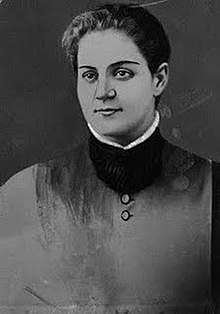
This blog/episode was written by Sarah (Good Nightmare) and Kate (Ignorance Was Bliss).
Jane Toppan was an American woman with an unusual goal – “to have killed more people – helpless people – than any man or woman who ever lived.”
Jane was born August 17, 1853 as Honora Kelly, to Irish immigrants, Peter and Bridget Kelley. Bridget passed away early in Jane’s life, from tuberculosis, and her father was a known alcoholic and abuser, known locally as “Kelley the Crack”, alluding to being a “crackpot”.
Peter Kelley’s life was as fractured and disturbed as his daughter’s would become. In 1863, a few years after his wife passed away, Peter took his two youngest daughters, Delia Josephine (8) and Honora (6) to the Boston Female Asylum. The asylum was an orphanage for indignant female children and not unusual for its day. It was founded in 1799 by Hanna Stillman, and was run by an all-female board. The mission of the asylum was to “receive… protect… and instruct… female orphans until the age of 10 years, when they are placed in respectable families.” Documentation from the asylum stats that Kelley’s children were “rescued from a very miserable home.”
In his later years, Kelley was a target of rumours concerning his alleged insanity. He was known to be an alcoholic, and this, paired with possible late-stage syphilis (which can cause blindness), could have been the root of the most popular rumour of the time: that Kelley’s insanity eventually drove him to sew his own eyelids closed while working as a tailor.
There are no records of Delia and Honora’s time spent in the asylum, however it is believed that Delia went on to be a sex worker, and an older sister of theirs, Nellie, who had stayed with her father, went on to be committed to an asylum.
In 1864, Honora was placed in the home of Mrs. Ann C Toppan as an indentured servant in Lowell, Massachusetts. They immediately began calling her Jane, as Honora sounded too Irish. Ann Toppan was openly derisive and cruel to Jane, who developed an outwardly cheerful but inwardly rageful demeanor. She eventually took the last name of her benefactors, though not by legal means, and became known as Jane Toppan. Elizabeth, the Toppans’ own daughter, and Jane got along together in the home.
At age 18, Jane was released from the indenture agreement with a stipend of $50, but chose to remain in the Toppan home. After the death of Ann Toppan, Jane opted to remain with Elizabeth and her new husband, deacon Oramel Brigham. She remained in their home for ten years, then left under unclear circumstances. She enrolled in nursing school at age 28.
In Cambridge Hospital, she earned the nickname Jolly Jane for her persistent demeanor, but many of her classmates saw her as a liar and an inept caregiver. She began experimenting with morphine and atropine, and is suspected of having killed upwards of a dozen patients from 1887-1889.
One of the most well-known stories about Jane during this time period came from Amelia Phinney, who was assigned to Jane’s care after surgery. She recalled being given a bitter-tasting medicine “for pain,” then Jane climbing into bed with her and kissing her face all over. Someone walked past the door, startling Jane, who left hastily. Upon regaining consciousness, Amelia believed she had dreamt the encounter, until after reading about Jane in the newspaper, 14 years later.
By 1889, Jane had transferred to the more prestigious Massachusetts General Hospital, though she was dismissed in 1890. She falsified her papers and relied on her jolly temperament to gain recommendations from doctors to work as a private nurse in Boston and Cambridge.
In 1895, Jane was regarded as the most successful private nurse in the area, though she had a reputation for alcoholism and malice after hours. It was at this point that she later confessed to her first deliberate murders, Israel Dunham, aged 83, followed by his wife, Lovely, aged 87, by poison of unknown origin. They were Jane’s landlords, and she despised them for being “feeble and fussy” and “old and cranky.”
Several more of her private patients died in mysterious, abrupt ways in the next few years, and by the summer of 1899, Jane was ready for a vacation. She joined her foster sister, Elizabeth, 69, on Cape Cod, then slowly poisoned her with strychnine. Several months later, while still in Woods Hole, MA, she killed an old friend, Sarah Myra Connors, 48, in order to take her job at the Theological School. A few years later, she did the same to housekeeper Mary Sullivan, and took her job as well.
Jane continued a steady pace of killing her friends and employers, with the most marked spree occurring in July 1901. Four members of the Davis family, mother Mattie, daughter Genevieve Gordon, father Alden, and daughter Minnie Gibbs, were all killed in the span of six weeks, along with several acts of arson and medical torture.
Jane left the area to pursue the affection of her foster sister’s widower, but by then police were investigating her as a suspect in multiple deaths. By the end of August 1901, Minnie Gibbs’ father-in-law had convinced the state to exhume the bodies of the Davis family. Jane read of this in the newspaper and headed to New Hampshire to stay with an old friend. She was arrested in October, 1901.
Eventually, Jane confessed to using combinations of morphine, atropine and strychnine to kill most of her victims. This combination of a sedative painkiller, a stimulant and an outright poison allowed her to manipulate and lengthen patients’ deaths, bringing them very close to death then returning them again several times before they ultimately died. She was famed for claiming that she got a sexual thrill out of the act, a report strengthened by Amelia Phillips’ story of Jane’s interaction with her post-surgery, but she also later stated that this was part of her efforts to appear insane and avoid prison.
Toppan eventually admitted to killing 31, but is suspected of actually being responsible for up to 100 deaths. She pled Not Guilty by Reason of Insanity, which the jury believed, and she was committed to the Taunton State Hospital. She died 35 years later, in 1938, of apparent old age.
Two stories about Jane’s time at the hospital are regularly told, even today. One is that, for a while, she refused to eat any food that hospital staff prepared, insisting that it was poisoned. The other is that, as she grew older, she would whisper to the staff, “Get some morphine, dearie, and we’ll go out in the ward. We’ll have a lot of fun, seeing them die.”