31. Jane Toppan Ft. Ignorance Was Bliss

Episode 31. Jane Toppan Ft. Ignorance Was Bliss.
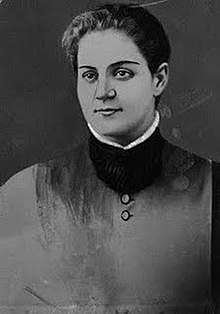
Image result for jane toppan

This blog/episode was written by Sarah (Good Nightmare) and Kate (Ignorance Was Bliss).

Jane Toppan was an American woman with an unusual goal – “to have killed more people – helpless people – than any man or woman who ever lived.”

Jane was born August 17, 1853 as Honora Kelly, to Irish immigrants, Peter and Bridget Kelley. Bridget passed away early in Jane’s life, from tuberculosis, and her father was a known alcoholic and abuser, known locally as “Kelley the Crack”, alluding to being a “crackpot”.

Peter Kelley’s life was as fractured and disturbed as his daughter’s would become. In 1863, a few years after his wife passed away, Peter took his two youngest daughters, Delia Josephine (8) and Honora (6) to the Boston Female Asylum. The asylum was an orphanage for indignant female children and not unusual for its day. It was founded in 1799 by Hanna Stillman, and was run by an all-female board. The mission of the asylum was to “receive… protect… and instruct… female orphans until the age of 10 years, when they are placed in respectable families.” Documentation from the asylum stats that Kelley’s children were “rescued from a very miserable home.”

In his later years, Kelley was a target of rumours concerning his alleged insanity. He was known to be an alcoholic, and this, paired with possible late-stage syphilis (which can cause blindness), could have been the root of the most popular rumour of the time: that Kelley’s insanity eventually drove him to sew his own eyelids closed while working as a tailor.

There are no records of Delia and Honora’s time spent in the asylum, however it is believed that Delia went on to be a sex worker, and an older sister of theirs, Nellie, who had stayed with her father, went on to be committed to an asylum.

In 1864, Honora was placed in the home of Mrs. Ann C Toppan as an indentured servant in Lowell, Massachusetts. They immediately began calling her Jane, as Honora sounded too Irish. Ann Toppan was openly derisive and cruel to Jane, who developed an outwardly cheerful but inwardly rageful demeanor. She eventually took the last name of her benefactors, though not by legal means, and became known as Jane Toppan. Elizabeth, the Toppans’ own daughter, and Jane got along together in the home.

At age 18, Jane was released from the indenture agreement with a stipend of $50, but chose to remain in the Toppan home. After the death of Ann Toppan, Jane opted to remain with Elizabeth and her new husband, deacon Oramel Brigham. She remained in their home for ten years, then left under unclear circumstances. She enrolled in nursing school at age 28.

In Cambridge Hospital, she earned the nickname Jolly Jane for her persistent demeanor, but many of her classmates saw her as a liar and an inept caregiver. She began experimenting with morphine and atropine, and is suspected of having killed upwards of a dozen patients from 1887-1889.

One of the most well-known stories about Jane during this time period came from Amelia Phinney, who was assigned to Jane’s care after surgery. She recalled being given a bitter-tasting medicine “for pain,” then Jane climbing into bed with her and kissing her face all over. Someone walked past the door, startling Jane, who left hastily. Upon regaining consciousness, Amelia believed she had dreamt the encounter, until after reading about Jane in the newspaper, 14 years later.

By 1889, Jane had transferred to the more prestigious Massachusetts General Hospital, though she was dismissed in 1890. She falsified her papers and relied on her jolly temperament to gain recommendations from doctors to work as a private nurse in Boston and Cambridge.

In 1895, Jane was regarded as the most successful private nurse in the area, though she had a reputation for alcoholism and malice after hours. It was at this point that she later confessed to her first deliberate murders, Israel Dunham, aged 83, followed by his wife, Lovely, aged 87, by poison of unknown origin. They were Jane’s landlords, and she despised them for being “feeble and fussy” and “old and cranky.”

Several more of her private patients died in mysterious, abrupt ways in the next few years, and by the summer of 1899, Jane was ready for a vacation. She joined her foster sister, Elizabeth, 69, on Cape Cod, then slowly poisoned her with strychnine. Several months later, while still in Woods Hole, MA, she killed an old friend, Sarah Myra Connors, 48, in order to take her job at the Theological School. A few years later, she did the same to housekeeper Mary Sullivan, and took her job as well.

Jane continued a steady pace of killing her friends and employers, with the most marked spree occurring in July 1901. Four members of the Davis family, mother Mattie, daughter Genevieve Gordon, father Alden, and daughter Minnie Gibbs, were all killed in the span of six weeks, along with several acts of arson and medical torture.  

Jane left the area to pursue the affection of her foster sister’s widower, but by then police were investigating her as a suspect in multiple deaths. By the end of August 1901, Minnie Gibbs’ father-in-law had convinced the state to exhume the bodies of the Davis family. Jane read of this in the newspaper and headed to New Hampshire to stay with an old friend. She was arrested in October, 1901.

Eventually, Jane confessed to using combinations of morphine, atropine and strychnine to kill most of her victims. This combination of a sedative painkiller, a stimulant and an outright poison allowed her to manipulate and lengthen patients’ deaths, bringing them very close to death then returning them again several times before they ultimately died. She was famed for claiming that she got a sexual thrill out of the act, a report strengthened by Amelia Phillips’ story of Jane’s interaction with her post-surgery, but she also later stated that this was part of her efforts to appear insane and avoid prison.

Toppan eventually admitted to killing 31, but is suspected of actually being responsible for up to 100 deaths. She pled Not Guilty by Reason of Insanity, which the jury believed, and she was committed to the Taunton State Hospital. She died 35 years later, in 1938, of apparent old age.

Two stories about Jane’s time at the hospital are regularly told, even today. One is that, for a while, she refused to eat any food that hospital staff prepared, insisting that it was poisoned. The other is that, as she grew older, she would whisper to the staff, “Get some morphine, dearie, and we’ll go out in the ward. We’ll have a lot of fun, seeing them die.”



Source

Source

28. The Isles of Shoals Murders

Episode 28. The Isles of Shoals Murders.

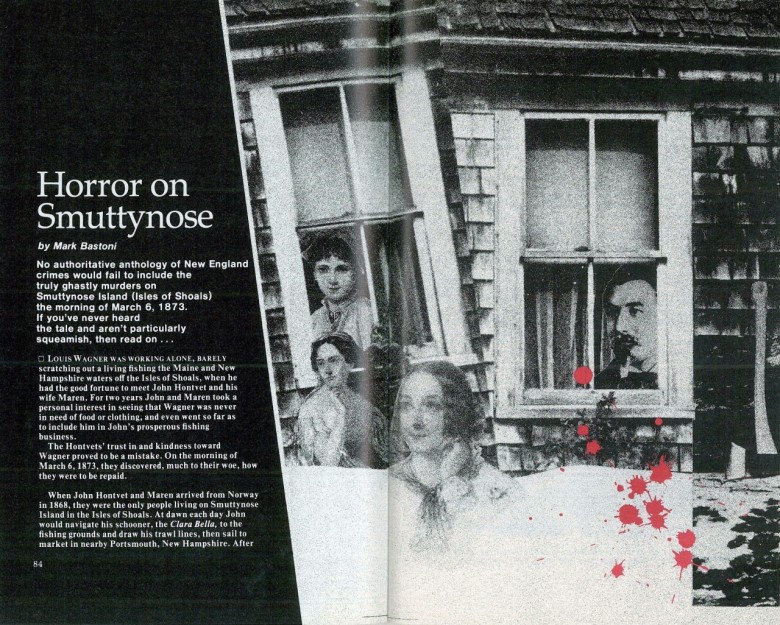
Horror on Smuttynose | The 1973 Smuttynose Murders

Horror on Smuttynose” from Yankee Magazine, 1980 | The 1873 Smuttynose Murders

This case was suggested by Tim Nichols.

Smuttynose Island is one of the Isles of Shoals in the United States. It was named by fishermen, who upon seeing the island, noticed that the seaweed collected at one end gave it the look of a great sea animal with a “smutty nose”. The island is best known for its association with a tragic double murder, the case we will be looking into today. 

In 1860, couple John and Maren Honvet moved to Smuttynose Island. For a while, they were the only two living there. John was a fisherman and would sail out to fish daily, before traveling to New Hampshire to sell his catch, and coming back home. Maren had a small dog, Ringe, who lived in the home with her and her family and friends. She was said to keep a bright and happy home, decorating with plants and bright wallpapers, though she missed her life in Norway, prior to moving to the Isle of Shoals.  

Two years after moving to the island, they met newcomer, Louis Wagner. Louis was 28, a well built man who kept quiet about his past. Though the Honvet’s would come to enjoy his company, the same couldn’t be said for others who had interacted with him.  The couple noticed that Louis was down on his luck. He was struggling to make ends meet and was wanting for company, food, clothing and income, and so the couple took him under their wing, so to speak. The three became friends and before long and it would come to be that John would include Louis in his successful fishing business. It was reported that Maren and Louis and John would become as close as siblings in their time together. 

In May 1871, Maren’s sister, Karen, came to the Isle of Shoals and was employed as a live in maid on a neighboring island. Maren was concerned for her sister who had suffered a heartache in Norway before coming to the Isle of Shoals. However, being in close proximity, the sisters were able to visit and keep in touch, which reassured Maren that she could help lift her sister’s spirits once again. 

By 1972, the Island would be met with more family members and friends. Louis Wagner moved into the Honvet’s home, and John’s brother Matthew, Maren’s brother Ivan and Ivan’s wife Anethe, came to live in the Honvet home, as well.  Anethe and Ivan had been married since Christmas and were very much in love. It was a crowded but a happy home, by all accounts. It was in 1972 that John invited Louis to join his lucrative fishing crew. 

Louis stayed with the Hotvet’s for five weeks after the family and friends moved into the home, and ten went on to join a fishing crew on the schooner the Addison Gilbert. By November, he had left Smuttynose altogether. Fate had it in for Louis, it seemed. The Addison Gilbert wrecked and Louis found himself working along the Portsmouth wharves, earning less than a living wage. Within months, he was destitute, his clothes were worn through, and he owed three weeks rent to the Jonsens’ whom he was living with. 

On March 5, 1873, Matthew, John and Ivan left to fish, per their usual routine. Karen, by this point, had ended her position as a live in maid and was now living with Maren and Anethe at their home. The men docked at Portsmouth and asked someone to send a message to the women on the island that they would not make it back home that night due to the strong winds. The women would be the only people on the island that night, and this would prove fatal for two of them. It was here at the docks that the men met Louis, who asked them if they would be returning to the island that night. They told him that it was likely they would not be able to return until morning, as they were awaiting the arrival of bait. 

It was 7.30pm when Louis was last seen at the port. He was apparently aware that the bait had not arrived and so the men would not be home. He then is said to have concocted a plan to burglarise the Honvet home. Louis Wagner reportedly stole a boat and returned to Smuttynose Island that night, making the journey alone, which would be come up in his defense at trial. It was a 12 mile journey, a lot for one man, but Louis was a skilled oarsman and had made the trip previously many times in a whaling boat. 

Having received a message earlier that afternoon that their husbands may not return home that night, it was around 10pm when the women prepared for bed, having decided not to wait up any longer.  

Wagner reportedly watched from afar, waiting until the women retired for the night, before entering the home when all was still and dark. The curtains had been left open that night as the weather was reasonably clear. 

According to Maren’s testimony, which is ultimately what convicted Louis, it was Karen who woke first. Since coming to stay on Smuttynose Island with her sister, Karen had been sleeping in the kitchen on a lounge. The lock to the front door was broken and had been for some time, so the intruder was able to enter quietly. Upon waking, Karen was startled to see a man standing in the home. She called out to her sister and Anethe that John had scared her. This roused Maren and Anethe who were sleeping in the bedroom they shared nearby. It was around this time that the clock in the kitchen fell to the floor and stopped at exactly 1.07am, recording the time of the murders. 

Louis, mistaken for John, picked up a chair from beside him and struck Karen with it. She began to call out to Maren and Anethe that John had killed her, her injuries proving life threatening. Maren attempted to open her bedroom door but found it was latched shut. She struggled with it while on the other side, Karen was being attacked. Maren managed to get the door open in time to see her sister slumped under the kitchen table. 

Maren took her sister by the arm and told her to hold the door while she opened the window for the three women to escape. Karen, however, gravely injured, told her sister that she couldn’t run, she couldn’t so much as get to the window, she was too tired. While pulling her sister into the bedroom, Maren had her back to the attacker and was struck twice with the same chair. When she couldn’t urge her sister to leave via the window, she called to Anethe to escape, to run and call for help. 

Anethe made it just outside the window, but frozen with fear, she was unable to run or call out. That is, until she saw the attacker approaching. It was then, under the light of the moon, that she hollered his name. Louis. He was within arms reach from the window and Maren was able to see him here, as well. Louis approached Anethe with an axe that had been kept at the home, and struck her in the head. 

Again, Maren tried to urge Karen to escape with her and run, but Karen was unable. Maren felt they may have more chance of survival if the two went separate ways, and so when Louis headed back toward the house, she fled through the open window, past the hen house, and out toward the dock. She had hoped to find Louis’s boat there so that she could escape, but came across none. Her dog, Ringe, stayed close, but she was afraid he would bark and alert Louis to her presence and so she ran and hit among rocks for the remainder of the night. 

It is at this point that Louis is thought to have dragged Anethe’s body back inside the house, where he turned on the lights in the home, made tea and a meal and eventually left with $15 more than he had arrived with. 

Maren did not leave her hiding place until just after sunrise. She flagged down children on a neighbouring island in the morning and Jorge, a man living on the island, sailed over to meet Maren and with her, discovered the murders.  

Ivan, John and Matthew, were alerted to the crime and were told to come home. The island was searched but there was no suspect to be found. It appeared Louis had escaped. John, Ivan and Matthew conveyed the story to authorities as relayed by Maren. 

Wagner’s description and whereabouts was given to police and he was found quickly. He was in new clothes and was headed to Boston. He was arrested. After his arrest, he was transferred from a local jail to Boston, among a crowd of hundreds who had heard of his terrible crime, and by the time he reached Portsmouth, it is said that a mob of thousands had gathered. 

Trial took place on the 9th of June, 1872. There was a total of 9 days of testimony and the jury took only 55 minutes of deliberation to find Wagner guilty, as charged. Maren gave her testimony at trial which is ultimately what convicted Wagner of the double murder. Though, he would proclaim his innocence until his end.  

Within the week of being sentenced, Wagner broke out of prison but was quickly recaptured. 

During the trial, Wagner’s only defense seemed to be that it would be too difficult for one man to row from the docks back to Smuttynose Island, though it was found by the prosecution and the jury that while this would have been difficult, it could be done. Especially by a man familiar with the trip, who had sailing experience, like he had, and who had made the trip several times previously in a whaling boat. 

It is said that Maren once confronted Louis in his cell before his trial. She was weak, and so she laid on a couch placed by the cell for her and simply stared at him. 

Wagner reportedly told her, “I am glad Jesus loves me.”, to which her husband John replied, “The Devil loves you.” 

On June 25, 1875, Louis Wagner was hanged. 

The aftermath of his crime was devastating and would leave many broken in its wake. Maren and John moved to Portsmouth shortly after the crimes, no longer having a reason to stay on the island, nor any desire. Ivan, devastated at the loss of his new wife and greatest love, was described as a broken man. He remained on Smuttynose Island until the end of summer, before moving home to Norway where he faded into obscurity. It is said that he never recovered.


Source

Source

Source

26. The Chase Family Vault

Episode 26. The Chase Family Vault.

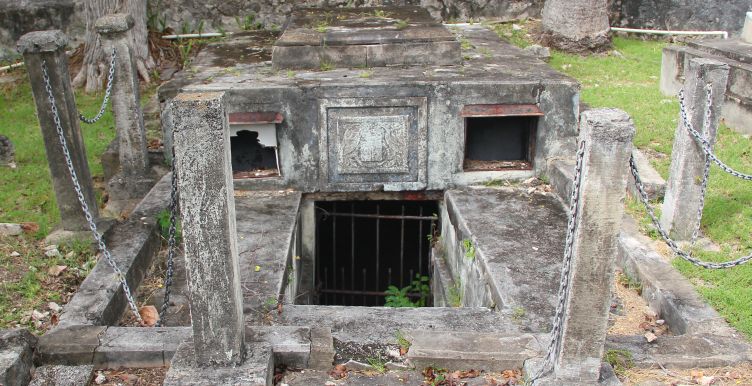
Chase vault

The Chase family vault.

Today’s blog is a listener suggestion from the lovely Casey. This is a story I was vaguely aware of but had never really taken time to investigate or look into. I’m glad that I did, and I think you will enjoy this one as much as I did. 

This is the story of the Chase family vault, and it takes place in Barbados, an area in the Lesser Antilles in the Southern Caribbean Sea. Supernatural activity at this site has been recorded as far back as 1802, when this story begins. 

The Chase family vault was originally constructed in 1724 for James Elliot. It was built on a hill overlooking the Christ Church Parish Cemetery and was half sunk into the ground. The vault could be accessed by stairs and was sealed with a heavy blue marble slab. The Chase family purchased the vault in 1808 to be used as a family tomb. At the time of the purchase, there was already one occupant – Thomasina Goddard. Thomasina had been buried in the vault in a wooden coffin where the family allowed her to remain, undisturbed. 

Coincidentally, the purchase of the vault resulted in its immediate use. 

In 1808, Thomas Chase’s infant child died under mysterious circumstances. The child was buried in a heavy lead casket that took several men to carry. 

In 1812, Dorcas Chase, Thomas’s daughter, also died under mysterious circumstances. It was rumoured that she had starved herself to death as an escape from the abuse she suffered at the hands of her father, though both the abuse and the cause of death were not confirmed in any records I could find. 

One month after Dorcas Chase’s death, Thomas himself died of an alleged suicide. Along with his children, he too was buried in a heavy metal casket that took several men to maneuver and was laid to rest in his tomb. 

It was while burying Thomas Chase that the first supernatural occurrence was discovered. The coffin of Dorcas Chase had been moved and was stood upright against a wall of the vault, as had the infants coffin.  The bodies themselves remained undisturbed, however, there was nothing stolen, nothing removed. It was put down to a case of vandalism, and once the caskets where returned to their original positions, the vault was again sealed. 

The vault remained sealed until 1816, when 11 year old Charles Brewster as to be buried. Upon opening the vault, it was found that the coffins again had been thrown into disarray. Just to reiterate, the vault was sealed by a marble slab that itself would take several people to move. The caskets themselves were said to require six to eight men to maneuver. The state that the caskets where found in was as though they had simply been picked up and tossed about the room. 

Again, the vault was put back into order and resealed. 

By this time, however, rumours of haunting, black magic and curses were beginning to surface. If animal death makes you uncomfortable, please skip the next 15 seconds or so as there is a brief mention. The accuracy of this claim is not proven, however, so may not have been any more than a story. 

A woman claimed that while passing the tomb on horseback, her horse had gone into a frenzy and had thrown her off. It was bucking, wild, and frothing at the mouth. Others in the area reported that their horses had been overtaken by the same wildness – they escaped their stables and fields and ran into a nearby river, where they subsequently drowned. 

1816 and 1819 brought the burials of Samuel Brewster and Thomasina Clark. Again, upon opening the vault, the iron and heavy metal caskets were found in disarray. The wooden coffin containing Thomasina Goddard, however, was again left undisturbed. 

It was decided that the vault would be examined, to determine how these events could possible occur, let alone occur repeatedly. Was it vandalism or something more? The vault was examined and it was determined that there was no other point of entry besides the descending stairs. A fine white sand was laid across the floor within the vault and it was then sealed with a mortar marked by a signet ring. It was closed and let be for eight months before being checked for signs of tampering. When reopened, there was no sign that the marble seal had been removed, and there wasn’t so much as a single footstep in the fine white sand. The caskets, however, were again, tossed about the room.  Thomas Chase’s casket had been pushed up against the entrance, as though in an attempt to block entry, or perhaps in attempt to escape.  

Nathan Lucas, a member of the Barbados House of Assembly, and an eye-witness to the disarray, ordered that the coffins would each be removed from the vault and buried separately around the cemetery. There has been no activity since the bodies were separated. 

This definitely begs the question, who was Thomasina Goddard? For her coffin, the only one light enough to be affected by flood or lifted by fewer than six men, was always left undisturbed. Was this the makings of a restless spirit, desiring to be left alone in her afterlife? Was it vandals, or, perhaps, was it all a lie? 

There has been no explanation given in the 200 years since the haunting details were reported. It is, however, considered by some to simply be no more than a tall-tale. Similar stories of disturbed vaults and graves have been told among the Freemasons, who claimed that the casket of the deceased founder of the Freemasons was often found tossed about in it’s vault. Even if it is simply a tale, you have to wonder why this was the particular family chosen for this rumour, and how so many people claim to have experienced it for themselves.

Surely they can’t all be lying? 


Source

Source

25. The Villisca Axe Murders

Episode 25. The Villisca Axe Murders.

An article in The Day Book, Chicago, 14 June 1912, depicting five of the victims and the house.

Today’s blog is particularly violent and involves the murder of children and a mention of assault against a child. If this is a topic that you are not comfortable with, I advise you skip this post or read with caution. As with all Good Nightmare blogs, I try to keep the gruesome details to a minimum, except where they are necessary to the detailing of a crime. 

The Villisca axe murders took place on June 9, 1912, in Iowa. 

The Moore family included Josiah and Sarah Moore, parents to Herman Montgomery (11), Mary Katherine (10), Arthur Boyd (7) and Paul Vernon (5). They were an affluent and well-known family, well liked by their community and involved in the local church. The weekend of the murders, the family was hosting guests Ina May (8) and Lena Gertrude Stillinger (12). 

Sarah and the children visited the Presbyterian Church the night of the 9th. The children attended the Children’s Day Program which Sarah presided over. The program ended at 9.30pm, and with a short walk home, the family returned to their house by 10pm. There were no reports of any disturbance or unusual behaviour on this night. 

The following morning, on June 10 at 7am, neighbour, Mary Peckman, was concerned to see that the usually punctual family had not appeared around the house for their morning chores. Mary approached the home and knocked on the door. When there was no answer, she tried the handle but it was locked. There was nothing she could do at this point to rouse the family from their apparent sleep, so she let out their chickens and called Josiah’s brother, Ross, for assistance. 

Noting Mary’s concern, Roy arrived at the house shortly after. He tried knocking and turning the door handle to no avail, so used his spare key to enter the house. What he would find was unfathomable. 

Ina and Lena’s bodies were discovered in the guest bedroom in a gruesome scene. 

Roy more immediately sent Mary Peckman to call for the town peace officer, Hank Horton. 

The search continued upon Hank’s arrival and the rest of the family was discovered. Each family member had been bludgeoned to death with an axe belonging to Josiah himself. The axe had been left in the guest room by the bodies of the two young guests. 

Given the family’s recorded arrival at their home around 10pm and their inability to be called forth from the home around 7am, it was determined that the murders took place somewhere between midnight and 5am. 

Officers found two smoked cigarettes in the attic, which lead them to believe that whomever had murdered the family and their guests, had waited inside the house for them to arrive home. It was determined that Sarah and Josiah had been killed first, while sleeping. Sarah and the other victims had all been bludgeoned with the blunt side of the axe, whereas Josiah had been attacked with the blade. He was attacked so severely that his eyes were missing, having been destroyed. This lends to the idea that either Josiah was considered enough of a threat to the killer to put a stop to the murders, that he needed to be taken out so to speak, or that this attack was specifically targeted towards the destruction of Josiah and his family, consequently. 

The Moore’s children were attacked next, and lastly, the two guests. 

All residents of the home were determined to have been asleep at the time of the attacks, except for Lena. Lena had a defensive wound on her arm that suggested she woke up during the attack or may have tried to fight back. Her nightgown was found pushed up and her underwear was missing when her body was found, suggesting an attempted assault. 

While there was minimal evidence, there was an abundance of suspects. 

Reverend George Kelly, Frank F Jones, William Mansfield, Loving Mitchell, Henry Lee Moore (of no relation) and Andy Sawyer were all investigated as suspects in the murder. I’ll let you decide which suspect you feel most fits the crime, and if you have other theories, please be sure to share them in the Facebook group. 

Reverend George Kelly was a travelling minister who was in town at the time of the murders. He was known for being peculiar and mentally unwell and was a suspected peeping Tom. Kelly was in attendance at the church on June 8, as he had come to teach at the Children’s Day Service and so could be connected to the Moore’s in this way. Kelly left town around 5am, June 10, the morning after the Moore murders. Kelly actually confessed to the crime but he was not believed. He showed a remarkable interest in the case and stayed in contact with investigating officers, claiming to have been at least a witness. 

In 1914, Kelly was arrested for sending obscene images via mail to a secretary he was had been consistently sexually harassing. He was subsequently sent to St Elizabeth’s Mental Hospital for treatment and detainment. In 1917, Kelly was arrested for the axe murders of the Moore family. He confessed to the crime but recanted shortly thereafter and was acquitted at his second trial. 

Frank F Jones was a local resident. He was also a previous employee of Josiah’s and it was rumoured that he had been involved in a sexual affair with one of Moore’s family members. This, combined with bad business experiences between the two led to the rumour that there was bad blood between the pair. The rumours, however, were unfounded. 

William Mansfield was a suspected serial killer. Two years after the Villisca axe murders, Mansfield murdered his own wife, infant child and in-laws. He was also a suspect believed to have committed the 1912 Paola, Kansas axe murders. The crime scenes were both accessible by train, and it was suggested that this is how he had moved around to commit various crimes. These axe murders were also said to have been linked to the New Orleans axe murders. Mansfield was released from custody having given a solid alibi for his whereabouts at the time of the murders. 

Henry Lee Moore, of no relation to the victims, was also a suspected serial killer. He murdered his own mother and grandmother just months after the Villisca axe murders, and as with Mansfield, was suspected in a slew of axe murders that had taken place around the same time. 

Andrew Sawyer was a transient. He traveled from place to place and stopped for work as he went. At 6am, the day the bodies were discovered, Sawyer approached a foreman looking for work. He was wet and muddy, and noted as being very interested in the murders. He would read articles about the murders alone on breaks and would mention them to other workers. Sawyer was said to be anxious about being alone and he would often sleep with an axe. Afraid of being considered a suspect, Sawyer attempted to leave Villisca. Though he seemed to have information about the crime, including how the murderer may have escaped the scene and skipped town, he was released from custody. He had a solid alibi. He’d been arrested for vagrancy the night of the murders and had been sent out of town at about 11pm, about an hour before the murders were said to have taken place. 

Cases could be made for any of these suspects, or at least for most of them. 

The case remains unsolved to this day. 

Bill James and Rachel McCarthy, in their novel, The Man From the Train, look at a series of axe murders that took place over 10 years, including the Villisca axe murders. They conclude that Paul Mueller was the perpetrator of each murder. However the pair admit that they only had about 500 words of information about the man’s skills, appearance and family. Regardless of who you believe is the killer, this novel would be an interesting read if you’re keen for mass consumption of detailed axe murders. I may have to keep an eye out for it myself. 

Who do you think the killer is?


Source


24. The Birdman of Alcatraz

Episode 24. The Birdman of Alcatraz.

Image result for robert stroud

Robert Stroud in 1951

Robert Stroud was born on January 28, 1890 to Elizabeth Jane and Benjamin Franklin Stroud, in Seattle, Washington. Benjamin was abusive and an alcoholic who would often subject Robert to his anger. Robert, at the young age of 13, ran away from home to escape the abuse and by 18 years of age, was employed as a pimp. At only 19, Robert would go from a fractured young man to a murderer, and would eventually become one of the most notorious criminals in the USA. 

In January, 1909, Stroud was informed that a John had allegedly refused to pay one of Stroud’s workers and had attacked her, ripping a locket from her neck. Stroud found the man, and beat him to unconsciousness for the assault before pulling out his gun and shooting the John point blank. This would be his first murder. He was sentenced to 12 years in a federal penitentiary. While incarcerated, Stroud became known as a volatile and violent prisoner. In 1916, on March 26, Shroud was reprimanded by prison guard Andrew F Turner for a minor rule violation. His punishment meant that Shroud would miss a visit from his younger brother, who he hadn’t seen in eight years. Shroud, feeling entitled and incensed, stabbed Turner through the heart with a shiv. He was convicted of first degree murder and sentenced to hang. However, following multiple trials, his sentence was commuted to life in prison. 

He remained volatile throughout his entire prison stay, and was reported to have viciously attacked an orderly who informed their superiors that Shroud had been trying to glean morphine from them using intimidation and threats. He is also reported to have stabbed a fellow inmate. It was his violent temper and actions that would see him ordered to be placed permanently in solitary confinement for the remainder of his sentence. 

In 1920, while in solitary confinement, Shroud discovered a birds next with three injured sparrows. Shroud took the birds in and nursed them back to health. Within only a few years, Shroud would be in possession of around 300 canaries. He would care for them, and trade them, sending any money he made to his mother. 

In spite of the over crowding in the prison, Shroud was ultimately given an additional cell to house his birds. As part of a prison reform program, Shroud was given equipment to care for the birds. He made his first cages for them out of wood and studied them in great detail. While incarcerated, Shroud wrote “Diseases of Canaries”, a draft which was smuggled from the prison and published in 1933. He made significant contributions to the field of ornithology, including developing a cure for hemorrhagic septicemia. 

In 1931, there was an attempt to shut down his bird trading business, and it may have been successful, had Della Mae Jones of Indiana not shared Shroud’s story with various newspapers and magazines. A 50,000 signature petition was sent to President Herbert Hoover and Shroud was then allowed to keep his birds. There was an attempt to move Shroud to another prison, however when Shroud discovered that a legally married prisoner was not able to be moved, he married Della Mae Jones. 

Shroud’s mother did not approve of the union. She was of the belief that women would cause nothing but trouble for her son, and though she had spent years trying to petition to have Shroud freed from prison, she cut off all communication with him until the time of her death. 

Shroud, again, would be responsible for his own downfall. It was discovered that he had been involved in the manufacture and trade of alcohol within the prison and was then to be transferred to Alcatraz in 1942. He spent six years of his time in Alcatraz in D Block in segregation and the following 11 years in the prison hospital. Shroud was known to play checkers through the bars of his cell with Correctional Officer George DeVincenzi. 

Shroud was a busy and intelligent man. When his birds were taken from him, he wrote a history of the penal system from within prison. In 1943, he was assessed by psychiatrist Romney M Mitchey and was officially labeled a psychopath, he had an IQ of 112. 

Shroud’s health declined towards the end of his life. In 1959, he was transferred to the Medical Centre for Federal Prisoners, Missouri, where he spent his days learning French until he passed away in 1963. He was 73 years old and would forever carry the title of being the Bird Man of Alcatraz. 

Shroud spent a total of 54 years incarcerated. 42 of those years were spent in solitary confinement. 

A film starring Burt Lancaster was also produced, titled Birdman of Alcatraz. Shroud was portrayed as a mild-mannered and intelligent, likable man, as opposed to his violent reality. Shroud was never permitted to view the film while incarcerated or hospitalised. 

The 1955 book, Birdman of Alcatraz by Thomas E Gaddis gives a more detailed recollection of Shroud’s life and contributions, though some readers to emphasise that this is a softer take on a man who was ultimately a psychopath, a pimp, and a murderer. This may be an interesting addition to any bird or true crime lover’s library. Let me know if you pick up a copy or if you’ve already read it, and what you think of Gaddis’ version of the tale. 


Source

Source

21. Oak Grove Jane Doe

Episode 21. Oak Grove Jane Doe.

220px-oak_grove_jane_doe_clothing

Clothes found related to the Oak Grove Jane Doe.

The Wisdom Light Murder is a particularly brutal case that took place in 1946 and that remains unsolved to this day. Please note that this episode involves dismemberment which may be uncomfortable for some listeners.   

The victim has never been identified, with only vague identifying features available such as height range, sex, and weight. She has been dubbed Jane Doe, in the absence of a known identity. 

Jane Doe was found one piece at a time in the Willamette River, south of Portland, Oregon over several months. The first discovery made was that of her torso, wrapped in burlap on April 12, 1946. Three people had been walking along the bank of the river when they noticed a burlap sack floating just offshore. They investigated the strange sighting, thinking that they may have found a sack of kittens and unraveled the burlap to find the torso of a white woman, along with several items of clothing. 

On April 13, Jane Doe’s right thigh and both arms were discovered, almost 10km from her torso, when two fishermen reported their finding. The men noted that they had actually seen the burlap package around 30 days before reporting it, but at first they hadn’t thought it to be anything suspicious. It wasn’t until they read of the discovery of the torso that they reported their finding. They had been wrapped with telephone wire and sash weights from a curtain. The hands and foot had been severed from the limbs and could not be located. 

In July the same year, the left thigh was discovered under the Oregon City Bridge, and on July 29 it was reported that bundle’s of women’s clothing had also been discovered in the Clackamas river, leading police to believe that the woman’s body had been dumped in both rivers. 

September brought the discovery of “fragments of a human scalp”, and in October, the woman’s severed head was located near where her torso had been found, stumbled upon by a married couple. 

The woman’s hands and feet have never been found. 

In the initial investigation, Ray Rilance, county coroner, estimated that Jane Doe was in her teens to early twenties, weighing around 50kg. He is quoted as saying the perpertator had done “rather a neat job – at least he knew where the joints were”.  

A pathologist from the University of Oregon, Warren Hunter, reported that the torso looked to belong to a woman of around 50, differing majorly from the initial findings. He believed that the woman was petite, with light brown hair. There were burn marks on the lower portion of the torso that also led him to believe that the woman had been tortured before her death. 

Upon discovery of the woman’s skull, it was determined that cause of death was likely blunt force trauma. The woman was dismembered post-mortem. While there were investigations into who the victim may have been, which involved looking into missing persons cases, ultimately no identification was made. 

As for suspects: 

On April 14, 1946, after the discovery of the torso, a man called in from Milwaukee to claim that he knew the woman’s identity and the location at which she had been dismembered. Police ultimately ruled this to be a false call. 

In July, 1951, the FBI interviewed Roy Moore, convicted murderer, who recounted in detail the murder and dismemberment of a woman who he claims he disposed of in the Molalla River but did not give any information linking him to the Oak Grove Jane Doe.  

As with any case with no new leads, and little evidence, the trail went cold. 

In 2004, the case was reopened by the Clackamas County Police Department, however in an interview in 2017, the Portland Police Bureau confirmed that evidence pertaining to the case had been lost. Evidence including the woman’s jaw bone, clothing, dentures and other remains. It’s believed that this evidence was lost some time in the 1950s. 

John Krummenacker, who was investigating the cold case in 2017, is quoted: “The end result is this – there’s a middle aged woman that was brutally murdered with a blunt force trauma blow to her head. Then [she] was sawn up, cut up, dismembered and thrown into the river like a piece of garbage”. There have been no new leads and it is likely the case will never be solved due to the loss of witnesses, evidence and documentation.  

It’s difficult to believe that a police department could lose such vital evidence for such a brutal case, though as with Bella and the Wych Elm, we know that this is not necessarily uncommon. There have been cases in the past of missing skulls, missing organs, often in cases that remain unsolved. I’m sure the conspiracy theorist in all of us pricks it’s ears whenever it hears something like this, especially when the evidence missing is so crucial or the actually body, or parts, of a victim. 

As for the possible identity of the victim, as mentioned, several missing persons cases were investigated for possible leads, though none seem to have come to fruition. 

In 1946, a notice was posted in the Altoona Mirror, looking for a Mrs. Marle N. Nastos, who had been missing since August 24, 1945. The notice describes her as follows: 

Aged 47… 5 feet, 2 inches tall, weighing 130 pounds with brown eyes and hair. 

A description that matched that of the Oak Grove Jane Doe, though I couldn’t find details as to why, it appears that Nastos was ruled out as a match. 

Crime writers JD Chandler and Joshua Fisher theorise that the murdered woman was Anna Schrader. Schrader had allegedly had an affair with a man named William Breunning, a married police lieutenant. During a heated argument in 1929, a gun was fired and Breunning broke several of Schrader’s ribs following, when he tackled her. 

Schrader had allegedly told friends in the weeks leading up to the discovery of the body, that she had been planning to move to Minnesota. Around the time the body was discovered, there was a notice in The Oregonian seeking Anna Schader, who was then considered missing. As of 2017, no public records of Anna’s life or death are known. Jane Doe’s physical description is said to have matched that of Anna Schrader. 

While Anna Shrader seems like a match for this unidentified woman, there were plenty of other missing woman who matched the description of Jane Doe at this time. It’s impossible to determine whether this theory holds water, especially given there is little to no remaining evidence for the case. 

The first tragedy occurred at the time of the murder. 

The second, at the callous dismemberment and disposal of the body. 

The third, at the loss of the evidence. 

And the final tragedy, is that the life and identity of this woman remains unknown, she will never be put to rest and her murderer will never be brought to justice. 


Source

Source

19. The Mary Celeste

Episode 19. The Mary Celeste.

300px-mary_celeste_as_amazon_in_1861

An 1861 painting of Mary Celeste (named Amazon at the time), by an unknown artist.

Ghost ships, or phantom ships, are vessels that are devoid of crew and life, often found in the ocean. They may have been deserted for any number of reasons, though these reasons are not always clear and the crew cannot always be found. This is the case of the Mary Celeste and the MV Joyita. 

The Mary Celeste was an American merchant brigantine, that is, put very simply, a two-masted ship. Mary Celeste was built in Nova Scotia and launched as Amazon in 1861 before being transferred to American ownership in 1868 and was given her new name.  

As an aside, if, like me, you’re wondering why ships and often also cars or other modes of transport are referred to as she or her, I have a little fun fact for you. Romance languages, stemming originally from Vulgar Latin (meaning common Latin), such as Spanish, Portuguese, French, Italian, Romanian and Catalan, often refer to ships or “the ship” as a female noun. That tradition since carried over into English, resulting in people referring to ships as she or her. 

The Mary Celeste sailed without fault until her 1872 voyage from New York to Genoa. She was discovered at sea by the Canadian brigantine Dei Gratia, dishevelled but in fine condition, under partial sail (meaning with all sails not in full use) and with her lifeboat missing. The crew was nowhere to be found. The cargo had been left intact, as had the captain and crew’s personal items. None of the crew members would ever be seen or heard from again. 

There were many theories at the hearing following her discovery, including mutiny, piracy, or fraud, though there was no evidence to support any of these as being the cause of the Mary Celeste crew’s demise. As happens with unsolved mysteries, further and possibly less likely theories arose, such as paranormal intervention, attack by giant squid, sea quakes or alcohol fumes from the ships cargo afflicting the crew. 

The Mary Celeste’s life at sea did not end here. She was handed over to new owners and was in service until 1885 when her captain deliberately wrecked her on the coast of Haiti in order to claim insurance. 

Given that the Mary Celeste was a well stocked ship, in great shape, it is hard to imagine why the ship would be abandoned by the entire crew. 

It was theorised at one point that the ship may have been abandoned in order to claim insurance, however at the Gibraltar hearing; there was no evidence to suggest this other than the ship having been over insured. The insurance companies never opened an inquiry into the case. 

During this voyage, there were Riffian pirates active in the area and naturally it was suggested that the ship may have been attacked, however this theory was ruled out on account of the ships cargo and the crew’s personal possessions being left untouched. Pirates would have pilfered the ship and taken anything valuable. The undisturbed items also lends to the idea that whatever caused the crew to flee, it wasn’t necessarily violent. 

This leaves either something natural or entirely unnatural. 

Aboard the ship was a sounding rod, used to alert the crew that the ship was taking on water. It was suggested that this rod may have been triggered by some kind of malfunction, causing the captain and crew to believe that the ship was rapidly taking on water and would have to be abandoned. There was a fair amount of water on the ship when it was found, which could have been the cause of a waterspout, also known as a non-super cell tornado over water.  It is said that this would account for the slightly disheveled state that the ship was found in. It’s not hard to believe that in the wide expanse of the ocean, that a crew who had abandoned ship, could be lost to a watery grave, never to be found.  

As is common in Good Nightmare stories, the facts of the case eventually became intertwined with myth and legend. In 1883, the Los Angeles Times retold the story of the Mary Celeste with some embellishments: 

“Every sail was set, the tiller was lashed fast, not a rope was out of place … The fire was burning in the galley. The dinner was standing untasted and scarcely cold … the log [was] written up to the hour of her discovery.” 

Other reports claimed that the ship was found 2,600km south of its actual location and that there were live chickens on board upon its discovery. 

It was in 1884 that the most memorable retelling was printed by a very familiar name, Arthur Conan Doyle, master of mysteries, himself. 

Doyle renamed the ship Marie Celeste as it is still commonly mistakenly called to this day. He wrote that the voyage took place in 1873 as the ship sailed from Boston to Libson, carrying passengers as well as the crew. He created a character named Septimus Goring who hated the white race and gathered members of the crew to murder their captain, J W Tibbs and steal the ship away to West Africa. Only one other passenger survived the murders, a man known as Jephson, who was only spared because he was in possession of a magical charm. Although this story is clearly fictitious and was never meant to be taken as face, the US Consul in Gibraltar was so intrigued that he inquired into whether any elements of the story may be true. 

A more serious, though equally ludicrous, theory was presented in The Strand Magazine in 1913, where it was told that all people on board were drowned or eaten by sharks after a platform created for a swimming competition collapsed into the sea. 

And most fantastically, in true sea horror story style, it was also suggested that the entire crew was picked off the ship one by one by a giant squid or octopus. Giant squid have been recorded to have reached 15 metres, or 49 feet, in length and have been known to attack ships. Though it’s hard to believe that if this was the way the crew were taken down, that the ship would have been left only slightly disheveled and not one single survivor would be left on board. 

Of course, while there are no solid answers, all theories are equally likely. Kind of like the Schrodinger’s cat of ships. Leaving it just as likely that there may have even been some kind of paranormal intervention, in the style of the Bermuda triangle disappearances or alien abduction. Personally, I’m not sure what to believe or rather, what I would like to believe. 

I do have a movie recommendation for you. Triangle is the 2009 film that follows a group of friends involved in a yachting accident who find refuge on their very own ghost ship. The story has elements of the legend of Sisyphus as well as plenty of thrills. I watched this movie three times and picked up on something new each time.  


Source300px-mary_celeste_as_amazon_in_1861

18. The Boyington Oak

Episode 18. The Boyington Oak.

170px-boyington_oak_in_mobile

Today’s story was recommended by @CynClement  who shared with me an equally beautiful and tragic hometown story. Beautiful if you believe in our suspect’s innocence, that is. 

Spirits can become attached to places, objects or people. The entities that attach themselves are said to be mostly intelligent entities with a strong emotional connection to the object, place or person, though of course with attachment to people, this can be endlessly more complicated. Today’s episode will look at a case of attachment to an object, or landmark. 

A spirit attachment doesn’t necessarily mean that a particular ghost is trapped within an object. Rather, it may mean that the residual energy of a spirit has imprinted itself. This usually occurs in situations that involve volatile or highly emotional experiences, as will be seen in this case. Otherwise, the object may act as a conductor for the spirit which may visit the object in a sense, or interact through it. 

The most common spirit attachments we tend to hear about are where intelligent beings attach themselves to or use dolls as conductors, such as Annabel or Robert, two infamous objects said to have malevolent spirits or entities attached to them. In this case, however, we are looking into a tree. 

The Boyington oak is located in Mobile, Alabama and is said to be haunted by the spirit of Charles R. S. Boyington. 

Mobile was experiencing rapid economic growth in the 1830s, when Charles arrived from Conneticut. He was a printer, operating printing presses and providing printing services to others. He was also a gambler. As we saw with Edgar Allan Poe, gambling rarely ends well in the 1800s. Boyington took up residence in a boarding house in the city. It was here in Mobile that he met Nathaniel Frost. There was some alleged tension between the two as Frost was said to owe Boyington money. On the night that the two were seen on a walk together to the Church Street Graveyard, Frost’s body was found near the cemetery. He had been stabbed to death and robbed. 

Boyington found himself in a very compromising position. Having been with Frost the night of his death, and with rumours of tension between the two, he was a prime suspect for the murder. He was subsequently convicted of the crim and sentenced to death by hanging, to be carried out on February 20, 1935. 

Up until the moment of his death, Boyington protested his innocence. Before hanging, he proclaimed that an oak would grow from his heart in proof of his innocence when his body was buried. Boyington was right. An oak tree did grow from his grave and still stands. The oak tree is located just outside of the cemetery since the brick wall surrounding it was moved back, and can be found on Bayou Street. Visitors claim to have heard voices and sounds of crying around the tree. 

Whether this is a true sign of Boyington’s innocence from beyond the grave or a strange coincidence it’s impossible to tell, I guess it depends on what you do or want to believe. Ultimately, the two men’s spirits would reside in the cemetery they visited as friends for eternity. 


Source

17. Who Put Bella Down the Wych Elm

Episode 17. Who Put Bella Down the Wych Elm.

280px-bella_graffiti

In the spring of 1943, on April 18, four young boys from Worcestershire, England were exploring Hagley Woods, located in the estate of Hagley Hall. The boys were spending their day together poaching on the estate belonging to Lord Cobham but they found much more than they bargained for when Bob Farmer climbed a large wych elm to look for birds nests. He glanced down into the hollow of the tree and found what he first thought was an animal skull, before noticing human teeth and hair. Spooked, he and his friends Robert Hard, Thomas Willetts and Fred Payne, left the skull where they had found it and fled. They agreed not to tell anyone about their discovery since they were on the estate illegally. However, being shaken by the event, the youngest of the four, Thomas Willetts, confessed to his parents about what they had found. 

Police were engaged to investigate the boys’ finding. Upon inspection they discovered an almost complete skeleton, along with a shoe, a wedding ring and clothing fragments. The skull was mostly in tact, the body, not so much. The remains of a human hand were found at a distance from the tree. There was hope that the identity or at least some details of the identity may be determined due to the in tact dental pattern and the remaining human hair on the skull. 

The skeleton was sent for forensic examination by Professor James Webster. It was determined that the body was that of a woman who had been dead for at least 18 months, concluding that time of death was sometime around or before October 1941. It is suggested, though I couldn’t confirm, that Bella may also have been a mother.  

There was a scrap of taffeta in the woman’s mouth which suggested that she may have been suffocated. The body itself was found in a trunk, and it was determined that the woman was placed in the trunk either while still alive or some time before rigor mortis set in, as she would not have fit otherwise. Rigor mortis is the third stage of death in which the body stiffens. In humans, this can occur within 4 hours of death. 

Police were able to determine what the woman may have looked like and attempted to compare her details to the records of several missing persons reports from the time of her death. Unfortunately, none of the records seemed to match the evidence. Her dental records were also sent to dentists but again, there was no match. 

In 1944, a message was written on a wall in Upper Dean Street, Birminham, reading “Who put Bella down the Wych Elm?”. Other messages supposedly in the same hand appeared in the years following. In the 1970s the slightly different message, “Who put Bella in the Witch Elm” was written on the Hagley Obselisk near the woman’s resting place. 

To this day the case remains unsolved. 

There are multiple theories regarding who the woman might be and how she may have met her demise. 

In 1944, a possible victim was reported to police, in their words, as a prostitute named Bella who had worked on Hagley Road. Bella had disappeared three years earlier. The graffiti artist using the name Bella in their writing suggested they may have been aware of the woman’s identity. Could this have been a case of murder at the hands of a man who frequented the road? 

In 1953, Una Mossop made a statement that her ex-husband, Jack Mossop, had been told by a man named van Ralt, that he had been the one who put Bella in the tree. Van Ralt claimed that he had been with a woman that night who had passed out, drunk, while they were driving. He claimed that the men put the woman in a hollowed out tree so that when she awoke she would be frightened of what had become of her. Jack Mossop ended living the remainder of his life in an insitution has he had recurring nightmares of a woman staring at him out of a tree. He passed away there and it was 10 years before his wife would come forward with her statement. The statement was questioned because of the amount of time it took to come to light. It also begs the question that if this were a prank, why was the body then found in a trunk and who stuffed taffeta down Bella’s throat? 

There have been two theories that Bella was a spy who was caught and murdered. However, one of these theories, naming her as Clara Bauerle, was dismissed as it was determined that Clara had in fact died in Berlin on December 16, 1942. The other theory was the Bella was actually Clarabella Dronkers, killed by German spies, for, quote, “knowing too much”. While this theory is both ominous and intriguing, there is no evidence to support it. 

In 1945, Margaret Murray proposed that Bella’s murder was a ritual killing, involved with witchcraft. She suggested this ritual was the Hand of Glory, in which the left hand of the person who has killed or committed a crime is severed. The left hand often being symbolically connected with evil or Satanism throughout history.  This, however, would imply that Bella was herself a murderess, or perhaps someone equally as evil as the people who murdered her. 

As for whether we will ever have answers? Unless DNA was extracted somehow, before the skull suddenly disappeared, it’s unlikely that we ever will. 

Bella’s skull went missing, or was “lost”, by Birmingham police. While there have been multiple searches into the documentation and possible location of the skull, it has not been located. You might think this is an impossible situation, but this isn’t the first time a person’s organs, bones, or documents have gone missing in a case still under investigation. 

Unless someone happens to stumble across a photograph resembling Bella’s sketch, it’s unlikely the woman’s true identity will ever come to light. The thought of disappearing in history so completely seems impossible in the modern age, with paper and electronic trails that we all leave behind. 

Tell me what theory you believe fits this case: Was Bella a spy? An unlucky woman who came across the wrong man? Let me know.


Source

14. Edgar Allan Poe

Episode 14. Edgar Allan Poe.

200px-edgar_allan_poe_daguerreotype_crop

1849 “Annie” daguerreotype of Poe

Poe is a name as easily recognised as Grimm, Shakespeare or Atwood.

Poe was a writer, editor and a critic. He wrote stories of the macabre, from insanity to murder. He is credited with being a staple in the invention of the detective story, and of science fiction and was the first well-known American writer to attempt to earn his living solely through his short stories and poetry. Just as would be expected now, it was not an easy way to live. 

In 1809, Edgar Poe was born. He was the second child of his parents, whose relationship, and life in one case, were not to last. Poe’s father left the family in 1810 and his mother passed away in 1811 of pulmonary tuberculosis, known then as consumption, leaving Edgar and his sibling orphaned. 

Edgar was taken in by John and Frances Allan. Though they never officially adopted the young boy, they raised him well into young adulthood. Their home life became turbulent when Edgar was entering into further education when money was already tight due to gambling. Edgar and John would often argue over funds. Poe attended the University of Virginia for only a year before he had to leave due to a lack of funds. He went on to enlist in the army under another name. He ended his military career early, knowing that he wanted to work solely as a writer. He published his first works, Tamerlane and Other Poems, in 1827, thus beginning his writing career. 

In 1830, John Allan married his second wife Louisa Patterson. The relationship was unsettled and the pair would often argue over the children Allan had had as a result of his affairs. This led to Poe being abandoned by his second father figure. He ended his military career by getting himself court-martialed, knowing he would be found guilty and subsequently dismissed. His charges were neglect of duty and disobedience of orders. 

Poe’s writing career began with poetry which soon moved to prose when he found himself struggling. He submitted stories to several publications and in 1833 won an award for his story “MS. Found in a Bottle”, a story about a man lost at sea and carried to the South Pole by a hurricane. When he finds himself aboard a new ship, he is unable to make use of the maps and tools and is not able to be seen by the elderly crewmen that travel with him. He steals writing materials from the captain and starts a journal which he then throws into the sea. The story ends when the ship approaches Antarctica and becomes caught in a whirlpool where it begins to sink. 

In 1835, Poe found himself working as an assistant editor for the Southern Literary Messenger in Richmond. He was fired shortly after when his boss caught him drunk on the job, though with promising behaviour, he was hired on once again. The same year, Poe would marry his 13 year old cousin. He was 26 at the time. It is said that she may have been the inspiration for some of his writing. She passed away after 11 years of marriage. She had fallen victim to tuberculosis and experienced her first symptoms while playing the piano and singing. Poe had described it as a blood vessel breaking in her throat. He began to drink more heavily in an attempt to cope with her impending death. 

Obviously no hero, but just a regular man, Poe actually alienated himself from the writing community at the time. He accused another infamous author, Henry Wadsworth Longfellow, author of Evangeline and The Divine Tragedy, of plagiarism. Longfellow, taking the high road, deigned not to respond. 

Poe’s instability and drinking only worsened after the death of his young wife. He attempted another relationship with Sarah Whitman but it did not survive because of his excessive drinking and unstable behaviour. He then went on to form a relationship with childhood love, Sarah Royster. 

Poe’s erratic behaviour continued up to the moment of his death. On October 3, 1849, Poe was found on the streets in, quote, “great distress and in need of immediate assistance”. He was taken to the Washington Medical College and passed away on 7, October 1849 at 5am. During his stay at the medical college, Poe was incoherent. No one could get a word out of him as to how he came to be wasted, dressed in another man’s clothes, and left on the street. It’s alleged that he repeatedly called the name “Reynolds” the night before he passed. His famous last words? “Lord, help my poor soul.” He was 40 years old. 

Poe’s cause of death remains a mystery to this day. Though some theories have been put forward such as inflammation of the brain due to alcoholism, heart disease, epilepsy and even syphilis or rabies. A theory that arose in 1872 was that Poe was forced to make a vote for a particular political candidate. Getting the victim into a mindless and vulnerable state was one of the first steps of this practice. Cases like these often ended in violence or murder. His death was officially ruled as phrenitis. Swelling of the brain. 

Smithsonianmag.com goes into further detail about some of these theories, and I recommend heading over for a read-through!

John Evangelist Walsh, in his book Midnight Dreary: The Mysterious Death of Edgar Allan Poe, puts forward the theory that Poe was indeed murdered. I have added this to my reading list. If you have read it, I would love to hear your thoughts. 

I also recommend reading a collection of Poe’s work, in whatever format suits you. I have a copy of his collected stories and poetry at home that I received as a teen but I haven’t dived into the entire book completely. I often will pick stories that I want to read and just enjoy them individually. 

As for my theory on his death, I think it was a combination of alcoholism, mental illness and perhaps violence.  I don’t believe that the mystery will ever be solved, but as the ladies from Wine and Crime would say – let’s speculate wildly. 

I also came across a bit of trivia which I hope is true. It’s said that Poe was quite a fan of cats and would often write with one perched on his shoulder or perhaps just nearby. 

Let me know your favourite poem or tale by Poe, your other favourite authors in a similar vein, and what theory catches your interest in regards to his death. 


Source

Source