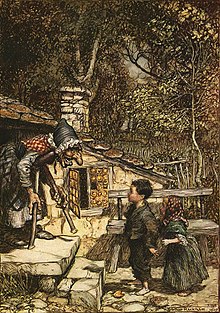
33. Hansel and Gretel

Illustration by Arthur Rackham, 1909


Hansel and Gretel was published by the Grimm brothers in 1812. The story was originally told to them by Wilhelm’s friend and future wife, Dortchen Wild. It’s believed that the story may have originated during the time of the Great Famine in 1315 – 1321, when starving families were forced to abandon their own children in order to assure their survival.  

Hansel and Gretel is the story of a young brother and sister who become lost in the woods and are kidnapped by a witch who lures them to her home made of gingerbread and candy. 

The following is the tale of Hansel and Gretel by the Brothers Grimm as it exists in the public domain. 

Hard by a great forest dwelt a poor wood-cutter with his wife and his two children. The boy was called Hansel and the girl Gretel. He had little to bite and to break, and once when great dearth fell on the land, he could no longer procure even daily bread. Now when he thought over this by night in his bed, and tossed about in his anxiety, he groaned and said to his wife: ‘What is to become of us? How are we to feed our poor children, when we no longer have anything even for ourselves?’ ‘I’ll tell you what, husband,’ answered the woman, ‘early tomorrow morning we will take the children out into the forest to where it is the thickest; there we will light a fire for them, and give each of them one more piece of bread, and then we will go to our work and leave them alone. They will not find the way home again, and we shall be rid of them.’ ‘No, wife,’ said the man, ‘I will not do that; how can I bear to leave my children alone in the forest?—the wild animals would soon come and tear them to pieces.’ ‘O, you fool!’ said she, ‘then we must all four die of hunger, you may as well plane the planks for our coffins,’ and she left him no peace until he consented. ‘But I feel very sorry for the poor children, all the same,’ said the man. 

The two children had also not been able to sleep for hunger, and had heard what their stepmother had said to their father. Gretel wept bitter tears, and said to Hansel: ‘Now all is over with us.’ ‘Be quiet, Gretel,’ said Hansel, ‘do not distress yourself, I will soon find a way to help us.’ And when the old folks had fallen asleep, he got up, put on his little coat, opened the door below, and crept outside. The moon shone brightly, and the white pebbles which lay in front of the house glittered like real silver pennies. Hansel stooped and stuffed the little pocket of his coat with as many as he could get in. Then he went back and said to Gretel: ‘Be comforted, dear little sister, and sleep in peace, God will not forsake us,’ and he lay down again in his bed. When day dawned, but before the sun had risen, the woman came and awoke the two children, saying: ‘Get up, you sluggards! we are going into the forest to fetch wood.’ She gave each a little piece of bread, and said: ‘There is something for your dinner, but do not eat it up before then, for you will get nothing else.’ Gretel took the bread under her apron, as Hansel had the pebbles in his pocket. Then they all set out together on the way to the forest. When they had walked a short time, Hansel stood still and peeped back at the house, and did so again and again. His father said: ‘Hansel, what are you looking at there and staying behind for? Pay attention, and do not forget how to use your legs.’ ‘Ah, father,’ said Hansel, ‘I am looking at my little white cat, which is sitting up on the roof, and wants to say goodbye to me.’ The wife said: ‘Fool, that is not your little cat, that is the morning sun which is shining on the chimneys.’ Hansel, however, had not been looking back at the cat, but had been constantly throwing one of the white pebble-stones out of his pocket on the road. 

When they had reached the middle of the forest, the father said: ‘Now, children, pile up some wood, and I will light a fire that you may not be cold.’ Hansel and Gretel gathered brushwood together, as high as a little hill. The brushwood was lighted, and when the flames were burning very high, the woman said: ‘Now, children, lay yourselves down by the fire and rest, we will go into the forest and cut some wood. When we have done, we will come back and fetch you away.’ 

Hansel and Gretel sat by the fire, and when noon came, each ate a little piece of bread, and as they heard the strokes of the wood-axe they believed that their father was near. It was not the axe, however, but a branch which he had fastened to a withered tree which the wind was blowing backwards and forwards. And as they had been sitting such a long time, their eyes closed with fatigue, and they fell fast asleep. When at last they awoke, it was already dark night. Gretel began to cry and said: ‘How are we to get out of the forest now?’ But Hansel comforted her and said: ‘Just wait a little, until the moon has risen, and then we will soon find the way.’ And when the full moon had risen, Hansel took his little sister by the hand, and followed the pebbles which shone like newly-coined silver pieces, and showed them the way. 

They walked the whole night long, and by break of day came once more to their father’s house. They knocked at the door, and when the woman opened it and saw that it was Hansel and Gretel, she said: ‘You naughty children, why have you slept so long in the forest?—we thought you were never coming back at all!’ The father, however, rejoiced, for it had cut him to the heart to leave them behind alone. 

Not long afterwards, there was once more great dearth throughout the land, and the children heard their mother saying at night to their father: ‘Everything is eaten again, we have one half loaf left, and that is the end. The children must go, we will take them farther into the wood, so that they will not find their way out again; there is no other means of saving ourselves!’ The man’s heart was heavy, and he thought: ‘It would be better for you to share the last mouthful with your children.’ The woman, however, would listen to nothing that he had to say, but scolded and reproached him. He who says A must say B, likewise, and as he had yielded the first time, he had to do so a second time also. 

The children, however, were still awake and had heard the conversation. When the old folks were asleep, Hansel again got up, and wanted to go out and pick up pebbles as he had done before, but the woman had locked the door, and Hansel could not get out. Nevertheless he comforted his little sister, and said: ‘Do not cry, Gretel, go to sleep quietly, the good God will help us.’ 

Early in the morning came the woman, and took the children out of their beds. Their piece of bread was given to them, but it was still smaller than the time before. On the way into the forest Hansel crumbled his in his pocket, and often stood still and threw a morsel on the ground. ‘Hansel, why do you stop and look round?’ said the father, ‘go on.’ ‘I am looking back at my little pigeon which is sitting on the roof, and wants to say goodbye to me,’ answered Hansel. ‘Fool!’ said the woman, ‘that is not your little pigeon, that is the morning sun that is shining on the chimney.’ Hansel, however little by little, threw all the crumbs on the path. 

The woman led the children still deeper into the forest, where they had never in their lives been before. Then a great fire was again made, and the mother said: ‘Just sit there, you children, and when you are tired you may sleep a little; we are going into the forest to cut wood, and in the evening when we are done, we will come and fetch you away.’ When it was noon, Gretel shared her piece of bread with Hansel, who had scattered his by the way. Then they fell asleep and evening passed, but no one came to the poor children. They did not awake until it was dark night, and Hansel comforted his little sister and said: ‘Just wait, Gretel, until the moon rises, and then we shall see the crumbs of bread which I have strewn about, they will show us our way home again.’ When the moon came they set out, but they found no crumbs, for the many thousands of birds which fly about in the woods and fields had picked them all up. Hansel said to Gretel: ‘We shall soon find the way,’ but they did not find it. They walked the whole night and all the next day too from morning till evening, but they did not get out of the forest, and were very hungry, for they had nothing to eat but two or three berries, which grew on the ground. And as they were so weary that their legs would carry them no longer, they lay down beneath a tree and fell asleep. 

It was now three mornings since they had left their father’s house. They began to walk again, but they always came deeper into the forest, and if help did not come soon, they must die of hunger and weariness. When it was mid-day, they saw a beautiful snow-white bird sitting on a bough, which sang so delightfully that they stood still and listened to it. And when its song was over, it spread its wings and flew away before them, and they followed it until they reached a little house, on the roof of which it alighted; and when they approached the little house they saw that it was built of bread and covered with cakes, but that the windows were of clear sugar. ‘We will set to work on that,’ said Hansel, ‘and have a good meal. I will eat a bit of the roof, and you Gretel, can eat some of the window, it will taste sweet.’ Hansel reached up above, and broke off a little of the roof to try how it tasted, and Gretel leant against the window and nibbled at the panes. Then a soft voice cried from the parlour: 

‘Nibble, nibble, gnaw,  Who is nibbling at my little house?’  

The children answered: 

‘The wind, the wind,  The heaven-born wind,’  

and went on eating without disturbing themselves. Hansel, who liked the taste of the roof, tore down a great piece of it, and Gretel pushed out the whole of one round window-pane, sat down, and enjoyed herself with it. Suddenly the door opened, and a woman as old as the hills, who supported herself on crutches, came creeping out. Hansel and Gretel were so terribly frightened that they let fall what they had in their hands. The old woman, however, nodded her head, and said: ‘Oh, you dear children, who has brought you here? do come in, and stay with me. No harm shall happen to you.’ She took them both by the hand, and led them into her little house. Then good food was set before them, milk and pancakes, with sugar, apples, and nuts. Afterwards two pretty little beds were covered with clean white linen, and Hansel and Gretel lay down in them, and thought they were in heaven. 

The old woman had only pretended to be so kind; she was in reality a wicked witch, who lay in wait for children, and had only built the little house of bread in order to entice them there. When a child fell into her power, she killed it, cooked and ate it, and that was a feast day with her. Witches have red eyes, and cannot see far, but they have a keen scent like the beasts, and are aware when human beings draw near. When Hansel and Gretel came into her neighbourhood, she laughed with malice, and said mockingly: ‘I have them, they shall not escape me again!’ Early in the morning before the children were awake, she was already up, and when she saw both of them sleeping and looking so pretty, with their plump and rosy cheeks she muttered to herself: ‘That will be a dainty mouthful!’ Then she seized Hansel with her shrivelled hand, carried him into a little stable, and locked him in behind a grated door. Scream as he might, it would not help him. Then she went to Gretel, shook her till she awoke, and cried: ‘Get up, lazy thing, fetch some water, and cook something good for your brother, he is in the stable outside, and is to be made fat. When he is fat, I will eat him.’ Gretel began to weep bitterly, but it was all in vain, for she was forced to do what the wicked witch commanded. 

And now the best food was cooked for poor Hansel, but Gretel got nothing but crab-shells. Every morning the woman crept to the little stable, and cried: ‘Hansel, stretch out your finger that I may feel if you will soon be fat.’ Hansel, however, stretched out a little bone to her, and the old woman, who had dim eyes, could not see it, and thought it was Hansel’s finger, and was astonished that there was no way of fattening him. When four weeks had gone by, and Hansel still remained thin, she was seized with impatience and would not wait any longer. ‘Now, then, Gretel,’ she cried to the girl, ‘stir yourself, and bring some water. Let Hansel be fat or lean, tomorrow I will kill him, and cook him.’ Ah, how the poor little sister did lament when she had to fetch the water, and how her tears did flow down her cheeks! ‘Dear God, do help us,’ she cried. ‘If the wild beasts in the forest had but devoured us, we should at any rate have died together.’ ‘Just keep your noise to yourself,’ said the old woman, ‘it won’t help you at all.’ 

Early in the morning, Gretel had to go out and hang up the cauldron with the water, and light the fire. ‘We will bake first,’ said the old woman, ‘I have already heated the oven, and kneaded the dough.’ She pushed poor Gretel out to the oven, from which flames of fire were already darting. ‘Creep in,’ said the witch, ‘and see if it is properly heated, so that we can put the bread in.’ And once Gretel was inside, she intended to shut the oven and let her bake in it, and then she would eat her, too. But Gretel saw what she had in mind, and said: ‘I do not know how I am to do it; how do I get in?’ ‘Silly goose,’ said the old woman. ‘The door is big enough; just look, I can get in myself!’ and she crept up and thrust her head into the oven. Then Gretel gave her a push that drove her far into it, and shut the iron door, and fastened the bolt. Oh! then she began to howl quite horribly, but Gretel ran away and the godless witch was miserably burnt to death. 

Gretel, however, ran like lightning to Hansel, opened his little stable, and cried: ‘Hansel, we are saved! The old witch is dead!’ Then Hansel sprang like a bird from its cage when the door is opened. How they did rejoice and embrace each other, and dance about and kiss each other! And as they had no longer any need to fear her, they went into the witch’s house, and in every corner there stood chests full of pearls and jewels. ‘These are far better than pebbles!’ said Hansel, and thrust into his pockets whatever could be got in, and Gretel said: ‘I, too, will take something home with me,’ and filled her pinafore full. ‘But now we must be off,’ said Hansel, ‘that we may get out of the witch’s forest.’ 

When they had walked for two hours, they came to a great stretch of water. ‘We cannot cross,’ said Hansel, ‘I see no foot-plank, and no bridge.’ ‘And there is also no ferry,’ answered Gretel, ‘but a white duck is swimming there: if I ask her, she will help us over.’ Then she cried: 

‘Little duck, little duck, dost thou see,  Hansel and Gretel are waiting for thee?  There’s never a plank, or bridge in sight,  Take us across on thy back so white.’  

The duck came to them, and Hansel seated himself on its back, and told his sister to sit by him. ‘No,’ replied Gretel, ‘that will be too heavy for the little duck; she shall take us across, one after the other.’ The good little duck did so, and when they were once safely across and had walked for a short time, the forest seemed to be more and more familiar to them, and at length they saw from afar their father’s house. Then they began to run, rushed into the parlour, and threw themselves round their father’s neck. The man had not known one happy hour since he had left the children in the forest; the woman, however, was dead. Gretel emptied her pinafore until pearls and precious stones ran about the room, and Hansel threw one handful after another out of his pocket to add to them. Then all anxiety was at an end, and they lived together in perfect happiness. My tale is done, there runs a mouse; whosoever catches it, may make himself a big fur cap out of it. 

If you’re looking for further reading, I would recommend picking up the fictive nonfictional text The Truth About Hansel and Gretel by Hans Traxler. This is a fictional text that reads like a real case study, attributing the origin of the tale to Hanz Metzler and his wife Grete. Hanza character is a baker who murders a woman in order to steal her gingerbread recipe, with the story taking place in the 17th century. 

 Though the book is ultimately untrue, there are a lot of believers who take it at its word. I was looking to purchase myself a copy, however I have only managed to find German prints, which I unfortunately can’t read. If you find an Italian or English copy, please let me know! I know enough Italian to read with a little help, and English is my first language, which would make it much easier.  

Alternatively, let me know if you have read the book or if you have a favourite retelling! 


Sources

http://www.gutenberg.org/files/2591/2591-h/2591-h.htm

https://en.wikipedia.org/wiki/Hansel_and_Gretel

32. Borley Rectory

Episode 32. Borley Rectory.

BorleyRectory1892.jpg

The east face of the rectory in 1892

A rectory, alternatively known as a priory, is housing provided by a church organization for a minister, priest or rector to live in. Rectories are often located close to or alongside churches, such as in this case. 

When Borley Rectory was built in 1862 by Reverend Henry Dawson Ellis, there was no inkling that it would one day become known as the most haunted house in England. The rectory was located in the village of Borley, in Essex, England, and was investigated and dubbed most haunted by Harry Price, a British psychic author and researcher. Price was renowned for exposing fraudsters but it appeared he whole-heartedly believed in the strange occurrences at Borley Rectory. In fact, he would write two books on the case, which he would become most famously known for.  

The Rectory itself would come to fame upon Price’s 1929 visit and the account subsequently published by the Daily Mirror. Price’s rival organisation, The Society for Psychical Research, claims to have discredited Price’s findings, however the case remains popular to this day in spite of doubts of the haunting being genuine. 

The Borley Rectory was built to replace a previous structure that had been destroyed by fire in 1841. Reverend Bull would move into the Rectory himself in the year following its completion. He would have an addition made the rectory that would act as a home for him and his fourteen children. 

The town of Borley came with a particularly disturbing legend, which some believed may have explained the haunting in the area, and especially at the Rectory. Though, there has been no historical basis for the legend, like a lot of lore, it continues to be told. 

The legend goes that there was once a nun and a monk living in the area. They fell in love, a love that was forbidden and began an affair. When the two were discovered, they were punished in a brutal manner. The monk was executed and the nun? She was taken to the Rectory, and bricked into it’s walls, alive, where she was left to die. 

The first reported signs of a haunting occurred at the Rectory in 1863 when locals claimed to have heard unexplained footsteps. From there, the haunting intensified and the witnesses would experience much of the same events. 

In 1890, July 28, four of the Bull daughters living at the Rectory believed they had seen an apparition of a nun only metres away. They tried to approach the figure and attempted to engage it by talking to it but they reported that the nun disappeared as they got closer. The children became so acquainted with the nun’s presence that they would welcome her presence and would go searching for her when she did no appear otherwise. 

The organist at the rectory reported that the family were “very convinced they had seen an apparition on several occasions”, though they didn’t claim to have seen anything themselves. This owed to the idea that the haunting either only affected the family, or it was some kind of group hysteria, or, not real at all. 

The nun was reported to have been seen by gusts of all ages, all walks of life, believers and non-believers in the paranormal. 

In W. H. Gregson’s article, Borley Rectory: The Most Haunted House in England, he describes the experience as follows: 

[The nun] used to gaze through a window in the gloomy dining room. Cheery, hospitable parties around the dining-table may have jarred upon her poor, agony-strained feelings. Suddenly, a strange chill would creep through the room. . . . a sudden silence fall, and one or other of those jovial diners would glance toward the window, would see there the pale, sad face, coiffed in grey. 

Those manifestations became so frequent that it was decided to end them by bricking up the window, and this was done. 

Untitled

 Since 1890, there were various accounts of witnesses seeing a phantom coach driven by headless horsemen. This account immediately reminded me of the tale of Sleepy Hollow, which features a headless horseman who rides through town, disturbing the people. Sleepy Hollow was published in English in 1820, and so had been available for 70 years prior to these sightings. It is possible that these experiences, if untrue, were inspired by the tale. 

Reverend Bull, the original and at this time the only owner of the Rectory passed away in 1892. His son, Reverend Henry “Harry” Bull took over the running of the rectory until his passing in 1928, leaving the Rectory vacant for some time. Young Reverend Bull died in 1928 leaving the Rectory vacant. 

In 1929 Reverend Guy Eric Smith and his wife moved into Borley Rectory. While cleaning the home, Smith’s wife came across an unusual package. Upon opening it, she discovered the skull of what was thought to be a young woman. There was no mention of the body’s location, or who it may have belonged to. Mrs Smith would also report hearing the ringing of servant’s bells which had been disconnected, unexplained footsteps and lights shining in windows. She also reported that she saw the phantom horse-drawn carriage that the Bell daughters had seen. 

After unrelenting haunting events, the Smiths asked to be put in touch with Society for Psychical Research (SPR) in 1929. At this point, Harry Price was working with the SPR and was sent to investigate Borley Rectory, arriving on June 12. 

Harry Price was a paranormal investigator of sorts. He was known for exposing fraudulent cases of séances and haunting and may have expected to do the same at the Borley Rectory, however, this case would become much more than he could have expected. 

Upon Price’s arrival, there were reports of new events. The throwing of stones, spirit messages tapped out on mirror frames in code, as well as apparitions, lights flashing and unexplained footsteps. It appeared the spirit’s presence was becoming more intense over time. However, when Price left the home, having completed his initial investigation, Reverend Smith’s wife claimed she suspected Price had faked some of the events, for example, throwing the stones and pebbles about himself. 

The Smith’s inhabitance of the home lasted less than a year, with the family vacating the property on July 14, 1929, though the property would not stay vacant for long. 

In 1930, Lionel Foster, his wife Marianne, and their adopted daughter Adelaide would move in. The family was immediately affected by the haunting. Lionel Foster began to keep a log of strange events which spanned the years 1930 to 1935. He noted the strange ringing of the disconnected bells, stones being thrown, writing on the walls that read “get help, Marianne”. There was even an account of his daughter, Adelaide, being locked in a room with no key and being attacked by “something horrible”. Marianne reported that in addition to the writings on the wall, she had also once been thrown from her own bed. Foyster decided to contact Harry Price to assist in the case. 

There were two exorcisms conducted on the home by Foyster, both without success. During the first exorcism, Foyster was struck on the shoulder with a large stone, about the size of a fist. Researchers who later reviewed the case believed that the events may have been triggered unknowingly or knowingly by Marianne. Marianne, however, believed it was her husband who had been working with psychic researchers to fraudulently create some of the events.  

Marianne may have had some motive to cause these events, perhaps to distract from what she had been doing behind closed doors. Marianne admitted that she had been having a sexual affair with a lodger, Frank Pearless, while living in Borley Rectory, and it is possible that the haunting was simply a cover. 

The Foysters left the Borley Rectory in October 1935. 

Price wished to continue his investigation and so he took out a rental agreement on the property for a year and on May 25, 1397 he ran an ad in the Times looking for researchers to live at the Rectory and record any supernatural events. 

The advertisement was as follows: 

“HAUNTED HOUSE: Responsible persons of leisure and intelligence, intrepid, critical, and unbiased, are invited to join rota of observers in a years night and day investigation of alleged haunted house in Home counties. Printed Instructions supplied. Scientific training or ability to operate simple instruments an advantage. House situated in lonely hamlet, so own car is essential. Write Box H.989, The Times, E.C.4” 

As a result of this ad, he was able to engage 48 observers, mostly students, who would spend time at the now empty rectory. He printed the first ever handbook on how to undertake a paranormal investigation and handed one to each of the participants. Some investigators brought their own equipment to the scene, others worked strictly by the handbook, and over the next few years, there would be some notable events. 

In 1938, Helen Glanville, conducted a séance in Streetham, South London in order to contact spirits and shed light on the case. Price claimed that Helen made contact with two spirits. One of the spirits was a nun name Marie Lairre. Marie communicated that she was a French nun who had left her convent and traveled to England. Her life would come to an abrupt and tragic end, however, when she was murdered and her body was either buried in the walls of a well, or thrown into a disused well. This tale was very similar to the lore about the nun bricked into the Rectory walls that was common in the town. 

Second spirit Helen was able to contact, called himself Sunex Amures and he warned that he would set fire to the Borley Rectory on March 27, 1938 in order to reveal the bones of a murder victim resting beneath the structure. The fire did not take place that particular night, but it did occur the following year, and later on, in 1943, there would be a gruesome discovery, but not before some other suspicious events would take place. 

27 Feb 1939, new owner Captain W. H. Gregson who had taken ownership of the home was unpacking when he knocked over an oil lamp causing a fire to spread through and damage the Rectory. 

In his own words, from the article Borley Rectory “The Most Haunted House in England”, he describes his experience: 

 I bought the Rectory (which I then re-named Priory, in commemoration of its traditional origin) in full knowledge of its Ghostly reputation, and in complete skepticism. 

I have since found ample cause to admit that there are influences existing, and active, in and around the place, which are outside the limits of what we are accustomed to consider the normal. 

The disastrous fire at the Rectory may have had some disturbing influence because, during the night of the fire, several people report having seen me, accompanied by two “Strangers,” one, a “Lady, dressed in a grey cloak,” the other, “A gentleman with a sort of bald head, dressed in a long black gown.” 

Already, the fate of my two spaniels has been published and broadcast far and wide. How, first, wise old “Peter” (a five-year-old black Cocker) and afterwards “Joe” (six-month-old Cocker) showed their dread of the gloomy Courtyard; how, even during daylight, they could scarcely be persuaded to enter it, and how each in turn went mad with terror at something which they sensed beyond the threshold of the Courtyard, and died mad. 

The insurance company that investigated the fire ultimately ruled it arson which implies heavily that a lot of his testimony of the hauntings should be taken with a grain, or perhaps a handful, of salt. 

Years later, in 1943, Harry Price conducted a dig in the cellars of the Rectory and discovered the bones of a young woman. The bones were given a Christian burial, though the parish of Borley refused to hold the ceremony, being of the opinion that the bones were not that of a young woman, but those of a pig. 

A report by the Society for Psychical Research, by this time Price’s rival organisation, found that many of the phenomena that occurred at the Rectory had indeed been faked by Price. Charles Sutton claimed that in 1929 he had found Price to have pockets filled with pebbles of all sizes during his investigation, which explained the reports of rocks being thrown. Many other events were put down to natural occurrences, such as rats causing strange sounds in the house that may have accounted for the footsteps. The writing on the wall directed to Marianne, may have been done by Marianne, herself. In fact, later in life, Marianne Foyster claimed she had not really seen any apparitions and believed the strange noises were just the wind, friends in the home, or admitted that she herself had taken to playing pranks on her husband.  

Many of Bull’s 14 children, the original owners of the Rectory, claimed to have been surprised that the house was considered haunted, having not experienced anything for themselves, including not having heard of the nun from their own siblings. 

Robert Hasting’s attempted to defend Price against fraud accusations but were unable to do so effectively given the thorough investigation by the Society of Psychical Research. 

Unfortunately, the house was ultimately demolished in 1944 so we may never be able to investigate for ourselves. Though, surely, if there were spirits attached to the area, they may still linger on. 

If you’ve visited the site, or something similar, I would love to hear from you.


Source

Source

31. Jane Toppan Ft. Ignorance Was Bliss

Episode 31. Jane Toppan Ft. Ignorance Was Bliss.

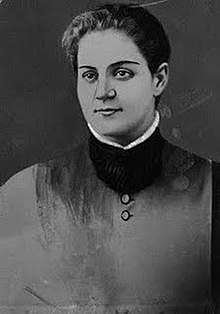
Image result for jane toppan

This blog/episode was written by Sarah (Good Nightmare) and Kate (Ignorance Was Bliss).

Jane Toppan was an American woman with an unusual goal – “to have killed more people – helpless people – than any man or woman who ever lived.”

Jane was born August 17, 1853 as Honora Kelly, to Irish immigrants, Peter and Bridget Kelley. Bridget passed away early in Jane’s life, from tuberculosis, and her father was a known alcoholic and abuser, known locally as “Kelley the Crack”, alluding to being a “crackpot”.

Peter Kelley’s life was as fractured and disturbed as his daughter’s would become. In 1863, a few years after his wife passed away, Peter took his two youngest daughters, Delia Josephine (8) and Honora (6) to the Boston Female Asylum. The asylum was an orphanage for indignant female children and not unusual for its day. It was founded in 1799 by Hanna Stillman, and was run by an all-female board. The mission of the asylum was to “receive… protect… and instruct… female orphans until the age of 10 years, when they are placed in respectable families.” Documentation from the asylum stats that Kelley’s children were “rescued from a very miserable home.”

In his later years, Kelley was a target of rumours concerning his alleged insanity. He was known to be an alcoholic, and this, paired with possible late-stage syphilis (which can cause blindness), could have been the root of the most popular rumour of the time: that Kelley’s insanity eventually drove him to sew his own eyelids closed while working as a tailor.

There are no records of Delia and Honora’s time spent in the asylum, however it is believed that Delia went on to be a sex worker, and an older sister of theirs, Nellie, who had stayed with her father, went on to be committed to an asylum.

In 1864, Honora was placed in the home of Mrs. Ann C Toppan as an indentured servant in Lowell, Massachusetts. They immediately began calling her Jane, as Honora sounded too Irish. Ann Toppan was openly derisive and cruel to Jane, who developed an outwardly cheerful but inwardly rageful demeanor. She eventually took the last name of her benefactors, though not by legal means, and became known as Jane Toppan. Elizabeth, the Toppans’ own daughter, and Jane got along together in the home.

At age 18, Jane was released from the indenture agreement with a stipend of $50, but chose to remain in the Toppan home. After the death of Ann Toppan, Jane opted to remain with Elizabeth and her new husband, deacon Oramel Brigham. She remained in their home for ten years, then left under unclear circumstances. She enrolled in nursing school at age 28.

In Cambridge Hospital, she earned the nickname Jolly Jane for her persistent demeanor, but many of her classmates saw her as a liar and an inept caregiver. She began experimenting with morphine and atropine, and is suspected of having killed upwards of a dozen patients from 1887-1889.

One of the most well-known stories about Jane during this time period came from Amelia Phinney, who was assigned to Jane’s care after surgery. She recalled being given a bitter-tasting medicine “for pain,” then Jane climbing into bed with her and kissing her face all over. Someone walked past the door, startling Jane, who left hastily. Upon regaining consciousness, Amelia believed she had dreamt the encounter, until after reading about Jane in the newspaper, 14 years later.

By 1889, Jane had transferred to the more prestigious Massachusetts General Hospital, though she was dismissed in 1890. She falsified her papers and relied on her jolly temperament to gain recommendations from doctors to work as a private nurse in Boston and Cambridge.

In 1895, Jane was regarded as the most successful private nurse in the area, though she had a reputation for alcoholism and malice after hours. It was at this point that she later confessed to her first deliberate murders, Israel Dunham, aged 83, followed by his wife, Lovely, aged 87, by poison of unknown origin. They were Jane’s landlords, and she despised them for being “feeble and fussy” and “old and cranky.”

Several more of her private patients died in mysterious, abrupt ways in the next few years, and by the summer of 1899, Jane was ready for a vacation. She joined her foster sister, Elizabeth, 69, on Cape Cod, then slowly poisoned her with strychnine. Several months later, while still in Woods Hole, MA, she killed an old friend, Sarah Myra Connors, 48, in order to take her job at the Theological School. A few years later, she did the same to housekeeper Mary Sullivan, and took her job as well.

Jane continued a steady pace of killing her friends and employers, with the most marked spree occurring in July 1901. Four members of the Davis family, mother Mattie, daughter Genevieve Gordon, father Alden, and daughter Minnie Gibbs, were all killed in the span of six weeks, along with several acts of arson and medical torture.  

Jane left the area to pursue the affection of her foster sister’s widower, but by then police were investigating her as a suspect in multiple deaths. By the end of August 1901, Minnie Gibbs’ father-in-law had convinced the state to exhume the bodies of the Davis family. Jane read of this in the newspaper and headed to New Hampshire to stay with an old friend. She was arrested in October, 1901.

Eventually, Jane confessed to using combinations of morphine, atropine and strychnine to kill most of her victims. This combination of a sedative painkiller, a stimulant and an outright poison allowed her to manipulate and lengthen patients’ deaths, bringing them very close to death then returning them again several times before they ultimately died. She was famed for claiming that she got a sexual thrill out of the act, a report strengthened by Amelia Phillips’ story of Jane’s interaction with her post-surgery, but she also later stated that this was part of her efforts to appear insane and avoid prison.

Toppan eventually admitted to killing 31, but is suspected of actually being responsible for up to 100 deaths. She pled Not Guilty by Reason of Insanity, which the jury believed, and she was committed to the Taunton State Hospital. She died 35 years later, in 1938, of apparent old age.

Two stories about Jane’s time at the hospital are regularly told, even today. One is that, for a while, she refused to eat any food that hospital staff prepared, insisting that it was poisoned. The other is that, as she grew older, she would whisper to the staff, “Get some morphine, dearie, and we’ll go out in the ward. We’ll have a lot of fun, seeing them die.”


Source

Source

30. Harry Price

Episode 30. Harry Price.

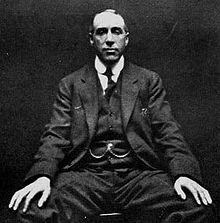
Harry price by william hope.jpg

A photograph of Harry Price, taken by paranormal hoaxer William Hope in 1922.

Today’s blog is an introduction of sorts to a case that will follow on, focused on the Borley Rectory. Be sure to subscribe to make sure you catch the next case.

Today, we look at the controversial investigator who made the case famous. 

Harry Price was born on January 17, 1881, in London. He was a fairly exceptional child, and at only 15 years old, he founded the Carlton Dramatic Society, for which he wrote plays about his experiences with poltergeists and the paranormal. He had had an interest in the supernatural from a very early age, and this would drive him further in his career, as well as shape his life and legacy. He would also come up against heavy, and often warranted, scrutiny throughout his careers. 

In 1908, Price pursued archaeology while working as a salesman and writing for the West Sussex Gazette and Southern Weekly News. His discoveries of “clean antiques” were often questioned in terms of their authenticity. For example, his discovery of an ingot stamped around the time of the Roman Emperor Honorious, who ruled from the year 393 – 423 was queried. An expert in Roman history declared that the ingot was indeed a fake, determined by its shape and lettering, which had been altered to make the ingot appear genuine. 

In 1920, discovering what would be a lifelong passion for conjuring, stage magic, and the paranormal, Price joined the Society for Psychical Research and in 1922, joined the Magic Circle. He would be involved in debunking multiple cases of fraudulent mediums having come to know various tricks of the trade by his involvement in stage magic and conjuring. Some of his more notable cases and movements in the spiritualist field follow: 

In 1922 Price and his colleagues, James Seymour, Eric Dingwall and William Marriott exposed spirit photographer William Hope. Price had marked Hope’s photographic plates without his knowledge, having etched them with a logo that would transfer to any images produced with them. Hope went on to produce several photographs of spirits claiming to have used these plates, however, none of those photos developed with the logo of the plates that had been provided to him. It was through this that Price was able to conclude that Hope had been substituting his regular plates for others which would allow him to print upon them images of spirits. 

In 1923 he exposed medium Jan Guzyk as faking events, stating that “man was clever, especially with his feet, which were almost as useful to him as his hands in producing phenomena.” in his book “Search for Truth: My Life for Psychical Research. It appeared that the medium had been using a very common trick in creating sounds and phenomena throughout his psychic readings using his feet. In 1925, he exposed Maria Silbert for the same. She would use her feet and toes to move objects during seances. 

In 1926, Price formed the organisation the National Laboratory of Psychical Research as a rival to the Society for Psychical Research. The two organisations would butt heads over years, each disputing each other’s findings. Price claimed that he had been attacked and bullied by Arthur Conan Doyle, a spiritualist, and yes, the same famed author who created Sherlock Holmes, who was frustrated with the damage Price had done to the spiritualist society in publishing a pamphlet that exposed Hope as a fake. Price wrote that “Arthur Conan Doyle and his friends abused me for years for exposing Hope.” Doyle had threatened to have Price removed from his laboratory should he continue to write such, quote, “sewage”, about the spiritualist movement. In other notable names, Price was friends with Houdini, the great magician, who also worked to debunk or expose fraudulent mediums and therefore had similar tensions with Doyle. 

These attacks on his character, albeit some likely very warranted given his controversial career involving the Borley Rectory especially, did not stop or slow Price’s momentum.  

Price made an offer to the University of London to provide and equip a Department for Psychical Research. The response was a positive one and the University accepted by the Board of Studies in Psychology. The Department was named the University of London Council for Psychical Investigation with Price acting as Honorary Secretary and editor. It was kept on as an unofficial board of the university. 

By 1940, Price’s career moved to focus heavily on writing. He produced several books, including The Most Haunted House in England, and The End of Boreley Rectory. Be sure to subscribed to this podcast to hear the strange and controversial tale of The Borley Rectory. 

Price’s death came swiftly on 29th of March, 1948 when he suffered a massive heart attack and died almost instantly at his home in Pulborough, West Sussex. He was 67. His archives were deposited with the University of London by his widow, including his correspondence, drafts of publications, press cuttings, photos, investigation notes and papers relating to libel cases. 


Source


29. The Voynich Manuscript

Episode 29. The Voynich Manuscript.

Voynich Manuscript (32).jpg

A floral illustration on page 32, Beinecke Rare Book and Manuscript Library,
Yale University

If you’re a fan of unsolved mysteries, you’ve likely heard of the Voynich Manuscript. I hadn’t, until I started going down a Wikipedia rabbit hole late one night. 

The Voynich Manuscript is a hand written and illustrated binding that has been carbon dated to the early 15th century. It’s named after Wilfrid Voynich, a Polish book dealer who purchased the manuscript in 1912. 

There was a cover letter retrieved from the text in 1912, when Voynich purchased it. The letter was dated in the year 1665, and read: 

Reverend and Distinguished Sir, Father in Christ: 

This book, bequeathed to me by an intimate friend, I destined for you, my very dear Athanasius, as soon as it came into my possession, for I was convinced that it could be read by no one except yourself. 

The former owner of this book asked your opinion by letter, copying and sending you a portion of the book from which he believed you would be able to read the remainder, but he at that time refused to send the book itself. To its deciphering he devoted unflagging toil, as is apparent from attempts of his which I send you herewith, and he relinquished hope only with his life. But his toil was in vain, for such Sphinxes as these obey no one but their master, Kircher. Accept now this token, such as it is and long overdue though it be, of my affection for you, and burst through its bars, if there are any, with your wonted success. 

Dr. Raphael, a tutor in the Bohemian language to Ferdinand III, then King of Bohemia, told me the said book belonged to the Emperor Rudolph and that he presented to the bearer who brought him the book 600 ducats. He believed the author was Roger Bacon, the Englishman. On this point I suspend judgement; it is your place to define for us what view we should take thereon, to whose favor and kindness I unreservedly commit myself and remain 

At the command of your Reverence, 

Joannes Marcus Marci of Cronland 

Prague, 19th August, 1665 

It’s place of origin is considered to be Northern Italy, and it’s language is unknown. Some scholars, code breakers, or fans, claim to have identified some of the language as either Latin or High German. Medieval scholars, however, have their doubts. It is suspected to have been previously owned by Roman Emperor Rudolph II, and has changed hands multiple times. It now resides with Yale. 

The manuscript itself contains only 240 out of the original 272 pages. It includes sections devoted to herbalism, astrology, biology, cosmology, pharmacology and various recipes. 

The manuscript is bound in goats skin, apparently not original to it. Most pages include drawings and diagrams, with colour for these thought to have been added in the 1600s. A work of ages. 

Given the nature of the drawings, diagrams and recipes, it has been suggested that the manuscript was originally used as a pharmacopoeia, addressing medieval and early modern medicine, likely for women’s health. 

There are notes included in the text, written in Latin and High German, though it hasn’t been confirmed whether these were part of the original text or if the annotations were added at a later date. 

The code of the manuscript has been studied for years, but the text has not yet been decoded or translated. Substitution codes have been ruled out as the repetition of certain characters does not occur as it would in any known language. There is no obvious punctuation throughout the text. Though, 20-25 unique characters have been identified which would be enough to make up the average alphabet. 

Some believe that the code is a short-hand, possibly stemming from Latin. Others believe that it may be a vowel-less alphabet, again, written in shorthand. There have been attempts as recent as 2018 to decode the manuscript, where it was thought to be Hebrew, written in an abnormal format. Medieval scholars, however, are skeptical of this translation and believe that the manuscript will never be deciphered. That is, if it was ever meant to be. There is always the chance that at the time of its creation, it was nothing but a hoax. 

Reprinted, high quality copies of the manuscript are available, complete with artwork. I’ve been considering buying one for myself from Booktopia. Though there’s obviously no chance I’ll be the one to crack the secret, it sounds like an inspiring object to own. 

The manuscript itself has inspired films, novels and symphonies. 


Source

Source

28. The Isles of Shoals Murders

Episode 28. The Isles of Shoals Murders.

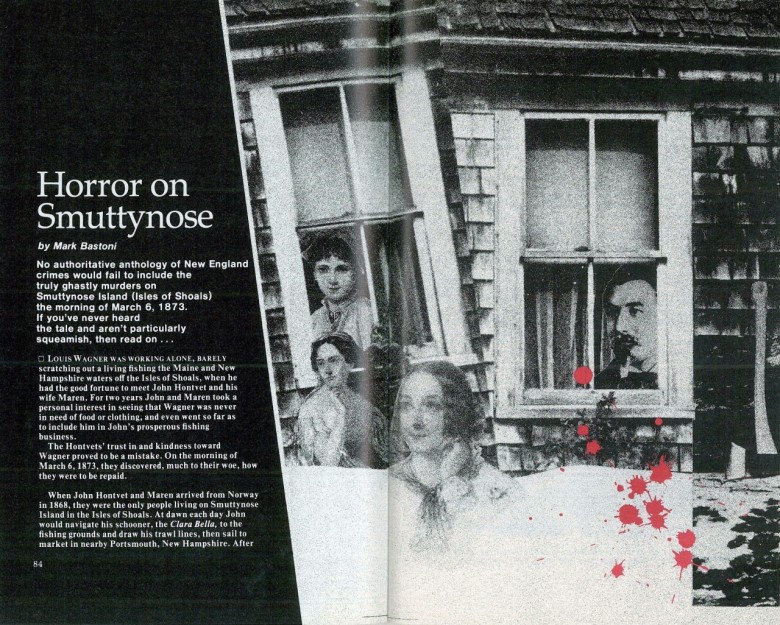
Horror on Smuttynose | The 1973 Smuttynose Murders

Horror on Smuttynose” from Yankee Magazine, 1980 | The 1873 Smuttynose Murders

This case was suggested by Tim Nichols.

Smuttynose Island is one of the Isles of Shoals in the United States. It was named by fishermen, who upon seeing the island, noticed that the seaweed collected at one end gave it the look of a great sea animal with a “smutty nose”. The island is best known for its association with a tragic double murder, the case we will be looking into today. 

In 1860, couple John and Maren Honvet moved to Smuttynose Island. For a while, they were the only two living there. John was a fisherman and would sail out to fish daily, before traveling to New Hampshire to sell his catch, and coming back home. Maren had a small dog, Ringe, who lived in the home with her and her family and friends. She was said to keep a bright and happy home, decorating with plants and bright wallpapers, though she missed her life in Norway, prior to moving to the Isle of Shoals.  

Two years after moving to the island, they met newcomer, Louis Wagner. Louis was 28, a well built man who kept quiet about his past. Though the Honvet’s would come to enjoy his company, the same couldn’t be said for others who had interacted with him.  The couple noticed that Louis was down on his luck. He was struggling to make ends meet and was wanting for company, food, clothing and income, and so the couple took him under their wing, so to speak. The three became friends and before long and it would come to be that John would include Louis in his successful fishing business. It was reported that Maren and Louis and John would become as close as siblings in their time together. 

In May 1871, Maren’s sister, Karen, came to the Isle of Shoals and was employed as a live in maid on a neighboring island. Maren was concerned for her sister who had suffered a heartache in Norway before coming to the Isle of Shoals. However, being in close proximity, the sisters were able to visit and keep in touch, which reassured Maren that she could help lift her sister’s spirits once again. 

By 1972, the Island would be met with more family members and friends. Louis Wagner moved into the Honvet’s home, and John’s brother Matthew, Maren’s brother Ivan and Ivan’s wife Anethe, came to live in the Honvet home, as well.  Anethe and Ivan had been married since Christmas and were very much in love. It was a crowded but a happy home, by all accounts. It was in 1972 that John invited Louis to join his lucrative fishing crew. 

Louis stayed with the Hotvet’s for five weeks after the family and friends moved into the home, and ten went on to join a fishing crew on the schooner the Addison Gilbert. By November, he had left Smuttynose altogether. Fate had it in for Louis, it seemed. The Addison Gilbert wrecked and Louis found himself working along the Portsmouth wharves, earning less than a living wage. Within months, he was destitute, his clothes were worn through, and he owed three weeks rent to the Jonsens’ whom he was living with. 

On March 5, 1873, Matthew, John and Ivan left to fish, per their usual routine. Karen, by this point, had ended her position as a live in maid and was now living with Maren and Anethe at their home. The men docked at Portsmouth and asked someone to send a message to the women on the island that they would not make it back home that night due to the strong winds. The women would be the only people on the island that night, and this would prove fatal for two of them. It was here at the docks that the men met Louis, who asked them if they would be returning to the island that night. They told him that it was likely they would not be able to return until morning, as they were awaiting the arrival of bait. 

It was 7.30pm when Louis was last seen at the port. He was apparently aware that the bait had not arrived and so the men would not be home. He then is said to have concocted a plan to burglarise the Honvet home. Louis Wagner reportedly stole a boat and returned to Smuttynose Island that night, making the journey alone, which would be come up in his defense at trial. It was a 12 mile journey, a lot for one man, but Louis was a skilled oarsman and had made the trip previously many times in a whaling boat. 

Having received a message earlier that afternoon that their husbands may not return home that night, it was around 10pm when the women prepared for bed, having decided not to wait up any longer.  

Wagner reportedly watched from afar, waiting until the women retired for the night, before entering the home when all was still and dark. The curtains had been left open that night as the weather was reasonably clear. 

According to Maren’s testimony, which is ultimately what convicted Louis, it was Karen who woke first. Since coming to stay on Smuttynose Island with her sister, Karen had been sleeping in the kitchen on a lounge. The lock to the front door was broken and had been for some time, so the intruder was able to enter quietly. Upon waking, Karen was startled to see a man standing in the home. She called out to her sister and Anethe that John had scared her. This roused Maren and Anethe who were sleeping in the bedroom they shared nearby. It was around this time that the clock in the kitchen fell to the floor and stopped at exactly 1.07am, recording the time of the murders. 

Louis, mistaken for John, picked up a chair from beside him and struck Karen with it. She began to call out to Maren and Anethe that John had killed her, her injuries proving life threatening. Maren attempted to open her bedroom door but found it was latched shut. She struggled with it while on the other side, Karen was being attacked. Maren managed to get the door open in time to see her sister slumped under the kitchen table. 

Maren took her sister by the arm and told her to hold the door while she opened the window for the three women to escape. Karen, however, gravely injured, told her sister that she couldn’t run, she couldn’t so much as get to the window, she was too tired. While pulling her sister into the bedroom, Maren had her back to the attacker and was struck twice with the same chair. When she couldn’t urge her sister to leave via the window, she called to Anethe to escape, to run and call for help. 

Anethe made it just outside the window, but frozen with fear, she was unable to run or call out. That is, until she saw the attacker approaching. It was then, under the light of the moon, that she hollered his name. Louis. He was within arms reach from the window and Maren was able to see him here, as well. Louis approached Anethe with an axe that had been kept at the home, and struck her in the head. 

Again, Maren tried to urge Karen to escape with her and run, but Karen was unable. Maren felt they may have more chance of survival if the two went separate ways, and so when Louis headed back toward the house, she fled through the open window, past the hen house, and out toward the dock. She had hoped to find Louis’s boat there so that she could escape, but came across none. Her dog, Ringe, stayed close, but she was afraid he would bark and alert Louis to her presence and so she ran and hit among rocks for the remainder of the night. 

It is at this point that Louis is thought to have dragged Anethe’s body back inside the house, where he turned on the lights in the home, made tea and a meal and eventually left with $15 more than he had arrived with. 

Maren did not leave her hiding place until just after sunrise. She flagged down children on a neighbouring island in the morning and Jorge, a man living on the island, sailed over to meet Maren and with her, discovered the murders.  

Ivan, John and Matthew, were alerted to the crime and were told to come home. The island was searched but there was no suspect to be found. It appeared Louis had escaped. John, Ivan and Matthew conveyed the story to authorities as relayed by Maren. 

Wagner’s description and whereabouts was given to police and he was found quickly. He was in new clothes and was headed to Boston. He was arrested. After his arrest, he was transferred from a local jail to Boston, among a crowd of hundreds who had heard of his terrible crime, and by the time he reached Portsmouth, it is said that a mob of thousands had gathered. 

Trial took place on the 9th of June, 1872. There was a total of 9 days of testimony and the jury took only 55 minutes of deliberation to find Wagner guilty, as charged. Maren gave her testimony at trial which is ultimately what convicted Wagner of the double murder. Though, he would proclaim his innocence until his end.  

Within the week of being sentenced, Wagner broke out of prison but was quickly recaptured. 

During the trial, Wagner’s only defense seemed to be that it would be too difficult for one man to row from the docks back to Smuttynose Island, though it was found by the prosecution and the jury that while this would have been difficult, it could be done. Especially by a man familiar with the trip, who had sailing experience, like he had, and who had made the trip several times previously in a whaling boat. 

It is said that Maren once confronted Louis in his cell before his trial. She was weak, and so she laid on a couch placed by the cell for her and simply stared at him. 

Wagner reportedly told her, “I am glad Jesus loves me.”, to which her husband John replied, “The Devil loves you.” 

On June 25, 1875, Louis Wagner was hanged. 

The aftermath of his crime was devastating and would leave many broken in its wake. Maren and John moved to Portsmouth shortly after the crimes, no longer having a reason to stay on the island, nor any desire. Ivan, devastated at the loss of his new wife and greatest love, was described as a broken man. He remained on Smuttynose Island until the end of summer, before moving home to Norway where he faded into obscurity. It is said that he never recovered.


Source

Source

Source

27. Reincarnation: Ryan Hammond & The Pollock Sisters

Episode 27. Reincarnation: Ryan Hammond & The Pollock Sisters

Gillian and Jennifer Pollock

The Pollock sisters.

Reincarnation is the theory that an aspect of a living being begins a new life in another body after experiencing a biological death. Reincarnation may occur when a person has unfinished business or has a balance they need to settle from their previous life. Children, who are considered to be more spiritually available to the “other side”, so to speak, are often the ones who exhibit signs that they may contain reincarnated souls. They may express memories, fears, dreams or desires for a life that has passed, or they may behave in the same way as a loved one they have never met. 

In today’s episode we will look at the stories of the Pollock sisters and Ryan Hammond, three children said to be reincarnations of former living beings. 

In Hexam, England in 1957,  sisters Joanna (11) and Jacqueline (6) were walking to church with a friend when they were struck and killed by a car. 

The girls’ parents, John and Florence, were naturally distraught over the loss of their daughters. Though the couple were Catholic, and Florence was skeptical, John was adamant that they would have another set of girls and that they would be their children, reborn into new life. He began speaking to others of his belief, though no one took much notice until Florence fell pregnant. With twins. 

Florence gave birth to two healthy young girls who she and her husband named Jennifer and Gillian. Jennifer was born with a mark on her forehead, in the same place as a wound sustained by Jacqueline in the accident. She also had a birth mark on her waist that was said to be identical to Jacqueline’s. Her parents were convinced that the twins were reincarnations of their lost daughters. The affirmations would only continue. 

Florence, John and their daughters moved to Whitney Bay when the girls were around three months old. They were not familiar with their older sisters lives or surroundings. At two years old, Jennifer and Gillian started asking their parents for toys that they didn’t own. Toys that had belonged to their older sisters. 

The family moved back to Hexam when the twins were four. The twins would recognise and name landmarks that would have been frequented by their older sisters, including the school the older girls had attended. They could call their older sisters’ dolls by their original names. They’d have recurring nightmares and wake in distress, having dreamt of being hit by a car, and when a car would pass them slowly on the street, the girls would explain that the car was coming to get them. 

With no explanation, the memories and signs of reincarnation stopped abruptly when the girls turned five. They never mentioned their previous life again. 

Skeptics might conclude that the girls had been told the story of their sisters enough to be able to speak about them, that they had heard about how their sisters were killed and that’s what brought on the nightmares, after all, that is a traumatic event to learn of. 

This next case, however, even the most rational mind may struggle with. 

In 2009, four-year-old Ryan Hammond began experiencing distressing nightmares. 

He would wake, calling for his mother, crying that his heart had exploded. He would tell her that he missed his old life, that the conditions he was living in weren’t up to par with what he was used to when he lived in Hollywood – well, perhaps not in so many words. Ryan had never lived in Hollywood. Nor had he had three children, lived on a street with Rock in the name, or had a friend named “Senator Fives”. Though, these were all memories that he distinctly recalled. 

It wasn’t until the day Cindi was looking through old Hollywood photographs that Ryan was able to identify himself. He pointed to a picture of two men, “that’s George!”, he said, “and that’s me!”. The man he claimed to have been was Martin Martyn, a Hollywood agent who had died in 1964. 

A reporter who was investigating the case got in contact with Martyn’s daughter, who confirmed that her father did in fact have a friend named George, and that he had another named Senator Ives. Cyndi took Ryan to meet Martyn’s daughter, however, when Ryan saw her he claimed that she was different. Cyndi had moved on from her loss. Ryan was described as standoffish and disinterested, as though he suddenly had no desire to be there with Martyn’s daughter. 

One psychiatrist explained this sudden change of heart as Martyn, or Ryan, having found closure. Apparently, when a reincarnated soul is able to see someone from their past life, and see that they have moved on, they are able to find peace, or closure, and therefore pass on to the other side, to whatever else may be waiting for them. 

What are your thoughts on reincarnation? It’s something I like to wonder about, personally. Whether it’s real or not, it’s nice to think that the possibility is there, that our souls are recycled. Perhaps that’s why we sometimes feel so immediately bonded to others when we first meet them, or why we experience déjà vu. Are there any cases that stand out to you? 

I plan to cover the case of Dorothy Eady, in future, so keep an eye out for that one!


Source

Source

Source

Source

26. The Chase Family Vault

Episode 26. The Chase Family Vault.

Chase vault

The Chase family vault.

Today’s blog is a listener suggestion from the lovely Casey. This is a story I was vaguely aware of but had never really taken time to investigate or look into. I’m glad that I did, and I think you will enjoy this one as much as I did. 

This is the story of the Chase family vault, and it takes place in Barbados, an area in the Lesser Antilles in the Southern Caribbean Sea. Supernatural activity at this site has been recorded as far back as 1802, when this story begins. 

The Chase family vault was originally constructed in 1724 for James Elliot. It was built on a hill overlooking the Christ Church Parish Cemetery and was half sunk into the ground. The vault could be accessed by stairs and was sealed with a heavy blue marble slab. The Chase family purchased the vault in 1808 to be used as a family tomb. At the time of the purchase, there was already one occupant – Thomasina Goddard. Thomasina had been buried in the vault in a wooden coffin where the family allowed her to remain, undisturbed. 

Coincidentally, the purchase of the vault resulted in its immediate use. 

In 1808, Thomas Chase’s infant child died under mysterious circumstances. The child was buried in a heavy lead casket that took several men to carry. 

In 1812, Dorcas Chase, Thomas’s daughter, also died under mysterious circumstances. It was rumoured that she had starved herself to death as an escape from the abuse she suffered at the hands of her father, though both the abuse and the cause of death were not confirmed in any records I could find. 

One month after Dorcas Chase’s death, Thomas himself died of an alleged suicide. Along with his children, he too was buried in a heavy metal casket that took several men to maneuver and was laid to rest in his tomb. 

It was while burying Thomas Chase that the first supernatural occurrence was discovered. The coffin of Dorcas Chase had been moved and was stood upright against a wall of the vault, as had the infants coffin.  The bodies themselves remained undisturbed, however, there was nothing stolen, nothing removed. It was put down to a case of vandalism, and once the caskets where returned to their original positions, the vault was again sealed. 

The vault remained sealed until 1816, when 11 year old Charles Brewster as to be buried. Upon opening the vault, it was found that the coffins again had been thrown into disarray. Just to reiterate, the vault was sealed by a marble slab that itself would take several people to move. The caskets themselves were said to require six to eight men to maneuver. The state that the caskets where found in was as though they had simply been picked up and tossed about the room. 

Again, the vault was put back into order and resealed. 

By this time, however, rumours of haunting, black magic and curses were beginning to surface. If animal death makes you uncomfortable, please skip the next 15 seconds or so as there is a brief mention. The accuracy of this claim is not proven, however, so may not have been any more than a story. 

A woman claimed that while passing the tomb on horseback, her horse had gone into a frenzy and had thrown her off. It was bucking, wild, and frothing at the mouth. Others in the area reported that their horses had been overtaken by the same wildness – they escaped their stables and fields and ran into a nearby river, where they subsequently drowned. 

1816 and 1819 brought the burials of Samuel Brewster and Thomasina Clark. Again, upon opening the vault, the iron and heavy metal caskets were found in disarray. The wooden coffin containing Thomasina Goddard, however, was again left undisturbed. 

It was decided that the vault would be examined, to determine how these events could possible occur, let alone occur repeatedly. Was it vandalism or something more? The vault was examined and it was determined that there was no other point of entry besides the descending stairs. A fine white sand was laid across the floor within the vault and it was then sealed with a mortar marked by a signet ring. It was closed and let be for eight months before being checked for signs of tampering. When reopened, there was no sign that the marble seal had been removed, and there wasn’t so much as a single footstep in the fine white sand. The caskets, however, were again, tossed about the room.  Thomas Chase’s casket had been pushed up against the entrance, as though in an attempt to block entry, or perhaps in attempt to escape.  

Nathan Lucas, a member of the Barbados House of Assembly, and an eye-witness to the disarray, ordered that the coffins would each be removed from the vault and buried separately around the cemetery. There has been no activity since the bodies were separated. 

This definitely begs the question, who was Thomasina Goddard? For her coffin, the only one light enough to be affected by flood or lifted by fewer than six men, was always left undisturbed. Was this the makings of a restless spirit, desiring to be left alone in her afterlife? Was it vandals, or, perhaps, was it all a lie? 

There has been no explanation given in the 200 years since the haunting details were reported. It is, however, considered by some to simply be no more than a tall-tale. Similar stories of disturbed vaults and graves have been told among the Freemasons, who claimed that the casket of the deceased founder of the Freemasons was often found tossed about in it’s vault. Even if it is simply a tale, you have to wonder why this was the particular family chosen for this rumour, and how so many people claim to have experienced it for themselves.

Surely they can’t all be lying? 


Source

Source

25. The Villisca Axe Murders

Episode 25. The Villisca Axe Murders.

An article in The Day Book, Chicago, 14 June 1912, depicting five of the victims and the house.

Today’s blog is particularly violent and involves the murder of children and a mention of assault against a child. If this is a topic that you are not comfortable with, I advise you skip this post or read with caution. As with all Good Nightmare blogs, I try to keep the gruesome details to a minimum, except where they are necessary to the detailing of a crime. 

The Villisca axe murders took place on June 9, 1912, in Iowa. 

The Moore family included Josiah and Sarah Moore, parents to Herman Montgomery (11), Mary Katherine (10), Arthur Boyd (7) and Paul Vernon (5). They were an affluent and well-known family, well liked by their community and involved in the local church. The weekend of the murders, the family was hosting guests Ina May (8) and Lena Gertrude Stillinger (12). 

Sarah and the children visited the Presbyterian Church the night of the 9th. The children attended the Children’s Day Program which Sarah presided over. The program ended at 9.30pm, and with a short walk home, the family returned to their house by 10pm. There were no reports of any disturbance or unusual behaviour on this night. 

The following morning, on June 10 at 7am, neighbour, Mary Peckman, was concerned to see that the usually punctual family had not appeared around the house for their morning chores. Mary approached the home and knocked on the door. When there was no answer, she tried the handle but it was locked. There was nothing she could do at this point to rouse the family from their apparent sleep, so she let out their chickens and called Josiah’s brother, Ross, for assistance. 

Noting Mary’s concern, Roy arrived at the house shortly after. He tried knocking and turning the door handle to no avail, so used his spare key to enter the house. What he would find was unfathomable. 

Ina and Lena’s bodies were discovered in the guest bedroom in a gruesome scene. 

Roy more immediately sent Mary Peckman to call for the town peace officer, Hank Horton. 

The search continued upon Hank’s arrival and the rest of the family was discovered. Each family member had been bludgeoned to death with an axe belonging to Josiah himself. The axe had been left in the guest room by the bodies of the two young guests. 

Given the family’s recorded arrival at their home around 10pm and their inability to be called forth from the home around 7am, it was determined that the murders took place somewhere between midnight and 5am. 

Officers found two smoked cigarettes in the attic, which lead them to believe that whomever had murdered the family and their guests, had waited inside the house for them to arrive home. It was determined that Sarah and Josiah had been killed first, while sleeping. Sarah and the other victims had all been bludgeoned with the blunt side of the axe, whereas Josiah had been attacked with the blade. He was attacked so severely that his eyes were missing, having been destroyed. This lends to the idea that either Josiah was considered enough of a threat to the killer to put a stop to the murders, that he needed to be taken out so to speak, or that this attack was specifically targeted towards the destruction of Josiah and his family, consequently. 

The Moore’s children were attacked next, and lastly, the two guests. 

All residents of the home were determined to have been asleep at the time of the attacks, except for Lena. Lena had a defensive wound on her arm that suggested she woke up during the attack or may have tried to fight back. Her nightgown was found pushed up and her underwear was missing when her body was found, suggesting an attempted assault. 

While there was minimal evidence, there was an abundance of suspects. 

Reverend George Kelly, Frank F Jones, William Mansfield, Loving Mitchell, Henry Lee Moore (of no relation) and Andy Sawyer were all investigated as suspects in the murder. I’ll let you decide which suspect you feel most fits the crime, and if you have other theories, please be sure to share them in the Facebook group. 

Reverend George Kelly was a travelling minister who was in town at the time of the murders. He was known for being peculiar and mentally unwell and was a suspected peeping Tom. Kelly was in attendance at the church on June 8, as he had come to teach at the Children’s Day Service and so could be connected to the Moore’s in this way. Kelly left town around 5am, June 10, the morning after the Moore murders. Kelly actually confessed to the crime but he was not believed. He showed a remarkable interest in the case and stayed in contact with investigating officers, claiming to have been at least a witness. 

In 1914, Kelly was arrested for sending obscene images via mail to a secretary he was had been consistently sexually harassing. He was subsequently sent to St Elizabeth’s Mental Hospital for treatment and detainment. In 1917, Kelly was arrested for the axe murders of the Moore family. He confessed to the crime but recanted shortly thereafter and was acquitted at his second trial. 

Frank F Jones was a local resident. He was also a previous employee of Josiah’s and it was rumoured that he had been involved in a sexual affair with one of Moore’s family members. This, combined with bad business experiences between the two led to the rumour that there was bad blood between the pair. The rumours, however, were unfounded. 

William Mansfield was a suspected serial killer. Two years after the Villisca axe murders, Mansfield murdered his own wife, infant child and in-laws. He was also a suspect believed to have committed the 1912 Paola, Kansas axe murders. The crime scenes were both accessible by train, and it was suggested that this is how he had moved around to commit various crimes. These axe murders were also said to have been linked to the New Orleans axe murders. Mansfield was released from custody having given a solid alibi for his whereabouts at the time of the murders. 

Henry Lee Moore, of no relation to the victims, was also a suspected serial killer. He murdered his own mother and grandmother just months after the Villisca axe murders, and as with Mansfield, was suspected in a slew of axe murders that had taken place around the same time. 

Andrew Sawyer was a transient. He traveled from place to place and stopped for work as he went. At 6am, the day the bodies were discovered, Sawyer approached a foreman looking for work. He was wet and muddy, and noted as being very interested in the murders. He would read articles about the murders alone on breaks and would mention them to other workers. Sawyer was said to be anxious about being alone and he would often sleep with an axe. Afraid of being considered a suspect, Sawyer attempted to leave Villisca. Though he seemed to have information about the crime, including how the murderer may have escaped the scene and skipped town, he was released from custody. He had a solid alibi. He’d been arrested for vagrancy the night of the murders and had been sent out of town at about 11pm, about an hour before the murders were said to have taken place. 

Cases could be made for any of these suspects, or at least for most of them. 

The case remains unsolved to this day. 

Bill James and Rachel McCarthy, in their novel, The Man From the Train, look at a series of axe murders that took place over 10 years, including the Villisca axe murders. They conclude that Paul Mueller was the perpetrator of each murder. However the pair admit that they only had about 500 words of information about the man’s skills, appearance and family. Regardless of who you believe is the killer, this novel would be an interesting read if you’re keen for mass consumption of detailed axe murders. I may have to keep an eye out for it myself. 

Who do you think the killer is?


Source


24. The Birdman of Alcatraz

Episode 24. The Birdman of Alcatraz.

Image result for robert stroud

Robert Stroud in 1951

Robert Stroud was born on January 28, 1890 to Elizabeth Jane and Benjamin Franklin Stroud, in Seattle, Washington. Benjamin was abusive and an alcoholic who would often subject Robert to his anger. Robert, at the young age of 13, ran away from home to escape the abuse and by 18 years of age, was employed as a pimp. At only 19, Robert would go from a fractured young man to a murderer, and would eventually become one of the most notorious criminals in the USA. 

In January, 1909, Stroud was informed that a John had allegedly refused to pay one of Stroud’s workers and had attacked her, ripping a locket from her neck. Stroud found the man, and beat him to unconsciousness for the assault before pulling out his gun and shooting the John point blank. This would be his first murder. He was sentenced to 12 years in a federal penitentiary. While incarcerated, Stroud became known as a volatile and violent prisoner. In 1916, on March 26, Shroud was reprimanded by prison guard Andrew F Turner for a minor rule violation. His punishment meant that Shroud would miss a visit from his younger brother, who he hadn’t seen in eight years. Shroud, feeling entitled and incensed, stabbed Turner through the heart with a shiv. He was convicted of first degree murder and sentenced to hang. However, following multiple trials, his sentence was commuted to life in prison. 

He remained volatile throughout his entire prison stay, and was reported to have viciously attacked an orderly who informed their superiors that Shroud had been trying to glean morphine from them using intimidation and threats. He is also reported to have stabbed a fellow inmate. It was his violent temper and actions that would see him ordered to be placed permanently in solitary confinement for the remainder of his sentence. 

In 1920, while in solitary confinement, Shroud discovered a birds next with three injured sparrows. Shroud took the birds in and nursed them back to health. Within only a few years, Shroud would be in possession of around 300 canaries. He would care for them, and trade them, sending any money he made to his mother. 

In spite of the over crowding in the prison, Shroud was ultimately given an additional cell to house his birds. As part of a prison reform program, Shroud was given equipment to care for the birds. He made his first cages for them out of wood and studied them in great detail. While incarcerated, Shroud wrote “Diseases of Canaries”, a draft which was smuggled from the prison and published in 1933. He made significant contributions to the field of ornithology, including developing a cure for hemorrhagic septicemia. 

In 1931, there was an attempt to shut down his bird trading business, and it may have been successful, had Della Mae Jones of Indiana not shared Shroud’s story with various newspapers and magazines. A 50,000 signature petition was sent to President Herbert Hoover and Shroud was then allowed to keep his birds. There was an attempt to move Shroud to another prison, however when Shroud discovered that a legally married prisoner was not able to be moved, he married Della Mae Jones. 

Shroud’s mother did not approve of the union. She was of the belief that women would cause nothing but trouble for her son, and though she had spent years trying to petition to have Shroud freed from prison, she cut off all communication with him until the time of her death. 

Shroud, again, would be responsible for his own downfall. It was discovered that he had been involved in the manufacture and trade of alcohol within the prison and was then to be transferred to Alcatraz in 1942. He spent six years of his time in Alcatraz in D Block in segregation and the following 11 years in the prison hospital. Shroud was known to play checkers through the bars of his cell with Correctional Officer George DeVincenzi. 

Shroud was a busy and intelligent man. When his birds were taken from him, he wrote a history of the penal system from within prison. In 1943, he was assessed by psychiatrist Romney M Mitchey and was officially labeled a psychopath, he had an IQ of 112. 

Shroud’s health declined towards the end of his life. In 1959, he was transferred to the Medical Centre for Federal Prisoners, Missouri, where he spent his days learning French until he passed away in 1963. He was 73 years old and would forever carry the title of being the Bird Man of Alcatraz. 

Shroud spent a total of 54 years incarcerated. 42 of those years were spent in solitary confinement. 

A film starring Burt Lancaster was also produced, titled Birdman of Alcatraz. Shroud was portrayed as a mild-mannered and intelligent, likable man, as opposed to his violent reality. Shroud was never permitted to view the film while incarcerated or hospitalised. 

The 1955 book, Birdman of Alcatraz by Thomas E Gaddis gives a more detailed recollection of Shroud’s life and contributions, though some readers to emphasise that this is a softer take on a man who was ultimately a psychopath, a pimp, and a murderer. This may be an interesting addition to any bird or true crime lover’s library. Let me know if you pick up a copy or if you’ve already read it, and what you think of Gaddis’ version of the tale. 


Source

Source