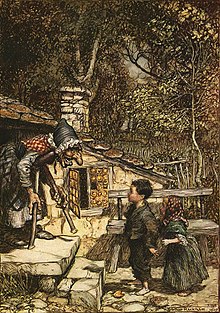
33. Hansel and Gretel

Illustration by Arthur Rackham, 1909


Hansel and Gretel was published by the Grimm brothers in 1812. The story was originally told to them by Wilhelm’s friend and future wife, Dortchen Wild. It’s believed that the story may have originated during the time of the Great Famine in 1315 – 1321, when starving families were forced to abandon their own children in order to assure their survival.  

Hansel and Gretel is the story of a young brother and sister who become lost in the woods and are kidnapped by a witch who lures them to her home made of gingerbread and candy. 

The following is the tale of Hansel and Gretel by the Brothers Grimm as it exists in the public domain. 

Hard by a great forest dwelt a poor wood-cutter with his wife and his two children. The boy was called Hansel and the girl Gretel. He had little to bite and to break, and once when great dearth fell on the land, he could no longer procure even daily bread. Now when he thought over this by night in his bed, and tossed about in his anxiety, he groaned and said to his wife: ‘What is to become of us? How are we to feed our poor children, when we no longer have anything even for ourselves?’ ‘I’ll tell you what, husband,’ answered the woman, ‘early tomorrow morning we will take the children out into the forest to where it is the thickest; there we will light a fire for them, and give each of them one more piece of bread, and then we will go to our work and leave them alone. They will not find the way home again, and we shall be rid of them.’ ‘No, wife,’ said the man, ‘I will not do that; how can I bear to leave my children alone in the forest?—the wild animals would soon come and tear them to pieces.’ ‘O, you fool!’ said she, ‘then we must all four die of hunger, you may as well plane the planks for our coffins,’ and she left him no peace until he consented. ‘But I feel very sorry for the poor children, all the same,’ said the man. 

The two children had also not been able to sleep for hunger, and had heard what their stepmother had said to their father. Gretel wept bitter tears, and said to Hansel: ‘Now all is over with us.’ ‘Be quiet, Gretel,’ said Hansel, ‘do not distress yourself, I will soon find a way to help us.’ And when the old folks had fallen asleep, he got up, put on his little coat, opened the door below, and crept outside. The moon shone brightly, and the white pebbles which lay in front of the house glittered like real silver pennies. Hansel stooped and stuffed the little pocket of his coat with as many as he could get in. Then he went back and said to Gretel: ‘Be comforted, dear little sister, and sleep in peace, God will not forsake us,’ and he lay down again in his bed. When day dawned, but before the sun had risen, the woman came and awoke the two children, saying: ‘Get up, you sluggards! we are going into the forest to fetch wood.’ She gave each a little piece of bread, and said: ‘There is something for your dinner, but do not eat it up before then, for you will get nothing else.’ Gretel took the bread under her apron, as Hansel had the pebbles in his pocket. Then they all set out together on the way to the forest. When they had walked a short time, Hansel stood still and peeped back at the house, and did so again and again. His father said: ‘Hansel, what are you looking at there and staying behind for? Pay attention, and do not forget how to use your legs.’ ‘Ah, father,’ said Hansel, ‘I am looking at my little white cat, which is sitting up on the roof, and wants to say goodbye to me.’ The wife said: ‘Fool, that is not your little cat, that is the morning sun which is shining on the chimneys.’ Hansel, however, had not been looking back at the cat, but had been constantly throwing one of the white pebble-stones out of his pocket on the road. 

When they had reached the middle of the forest, the father said: ‘Now, children, pile up some wood, and I will light a fire that you may not be cold.’ Hansel and Gretel gathered brushwood together, as high as a little hill. The brushwood was lighted, and when the flames were burning very high, the woman said: ‘Now, children, lay yourselves down by the fire and rest, we will go into the forest and cut some wood. When we have done, we will come back and fetch you away.’ 

Hansel and Gretel sat by the fire, and when noon came, each ate a little piece of bread, and as they heard the strokes of the wood-axe they believed that their father was near. It was not the axe, however, but a branch which he had fastened to a withered tree which the wind was blowing backwards and forwards. And as they had been sitting such a long time, their eyes closed with fatigue, and they fell fast asleep. When at last they awoke, it was already dark night. Gretel began to cry and said: ‘How are we to get out of the forest now?’ But Hansel comforted her and said: ‘Just wait a little, until the moon has risen, and then we will soon find the way.’ And when the full moon had risen, Hansel took his little sister by the hand, and followed the pebbles which shone like newly-coined silver pieces, and showed them the way. 

They walked the whole night long, and by break of day came once more to their father’s house. They knocked at the door, and when the woman opened it and saw that it was Hansel and Gretel, she said: ‘You naughty children, why have you slept so long in the forest?—we thought you were never coming back at all!’ The father, however, rejoiced, for it had cut him to the heart to leave them behind alone. 

Not long afterwards, there was once more great dearth throughout the land, and the children heard their mother saying at night to their father: ‘Everything is eaten again, we have one half loaf left, and that is the end. The children must go, we will take them farther into the wood, so that they will not find their way out again; there is no other means of saving ourselves!’ The man’s heart was heavy, and he thought: ‘It would be better for you to share the last mouthful with your children.’ The woman, however, would listen to nothing that he had to say, but scolded and reproached him. He who says A must say B, likewise, and as he had yielded the first time, he had to do so a second time also. 

The children, however, were still awake and had heard the conversation. When the old folks were asleep, Hansel again got up, and wanted to go out and pick up pebbles as he had done before, but the woman had locked the door, and Hansel could not get out. Nevertheless he comforted his little sister, and said: ‘Do not cry, Gretel, go to sleep quietly, the good God will help us.’ 

Early in the morning came the woman, and took the children out of their beds. Their piece of bread was given to them, but it was still smaller than the time before. On the way into the forest Hansel crumbled his in his pocket, and often stood still and threw a morsel on the ground. ‘Hansel, why do you stop and look round?’ said the father, ‘go on.’ ‘I am looking back at my little pigeon which is sitting on the roof, and wants to say goodbye to me,’ answered Hansel. ‘Fool!’ said the woman, ‘that is not your little pigeon, that is the morning sun that is shining on the chimney.’ Hansel, however little by little, threw all the crumbs on the path. 

The woman led the children still deeper into the forest, where they had never in their lives been before. Then a great fire was again made, and the mother said: ‘Just sit there, you children, and when you are tired you may sleep a little; we are going into the forest to cut wood, and in the evening when we are done, we will come and fetch you away.’ When it was noon, Gretel shared her piece of bread with Hansel, who had scattered his by the way. Then they fell asleep and evening passed, but no one came to the poor children. They did not awake until it was dark night, and Hansel comforted his little sister and said: ‘Just wait, Gretel, until the moon rises, and then we shall see the crumbs of bread which I have strewn about, they will show us our way home again.’ When the moon came they set out, but they found no crumbs, for the many thousands of birds which fly about in the woods and fields had picked them all up. Hansel said to Gretel: ‘We shall soon find the way,’ but they did not find it. They walked the whole night and all the next day too from morning till evening, but they did not get out of the forest, and were very hungry, for they had nothing to eat but two or three berries, which grew on the ground. And as they were so weary that their legs would carry them no longer, they lay down beneath a tree and fell asleep. 

It was now three mornings since they had left their father’s house. They began to walk again, but they always came deeper into the forest, and if help did not come soon, they must die of hunger and weariness. When it was mid-day, they saw a beautiful snow-white bird sitting on a bough, which sang so delightfully that they stood still and listened to it. And when its song was over, it spread its wings and flew away before them, and they followed it until they reached a little house, on the roof of which it alighted; and when they approached the little house they saw that it was built of bread and covered with cakes, but that the windows were of clear sugar. ‘We will set to work on that,’ said Hansel, ‘and have a good meal. I will eat a bit of the roof, and you Gretel, can eat some of the window, it will taste sweet.’ Hansel reached up above, and broke off a little of the roof to try how it tasted, and Gretel leant against the window and nibbled at the panes. Then a soft voice cried from the parlour: 

‘Nibble, nibble, gnaw,  Who is nibbling at my little house?’  

The children answered: 

‘The wind, the wind,  The heaven-born wind,’  

and went on eating without disturbing themselves. Hansel, who liked the taste of the roof, tore down a great piece of it, and Gretel pushed out the whole of one round window-pane, sat down, and enjoyed herself with it. Suddenly the door opened, and a woman as old as the hills, who supported herself on crutches, came creeping out. Hansel and Gretel were so terribly frightened that they let fall what they had in their hands. The old woman, however, nodded her head, and said: ‘Oh, you dear children, who has brought you here? do come in, and stay with me. No harm shall happen to you.’ She took them both by the hand, and led them into her little house. Then good food was set before them, milk and pancakes, with sugar, apples, and nuts. Afterwards two pretty little beds were covered with clean white linen, and Hansel and Gretel lay down in them, and thought they were in heaven. 

The old woman had only pretended to be so kind; she was in reality a wicked witch, who lay in wait for children, and had only built the little house of bread in order to entice them there. When a child fell into her power, she killed it, cooked and ate it, and that was a feast day with her. Witches have red eyes, and cannot see far, but they have a keen scent like the beasts, and are aware when human beings draw near. When Hansel and Gretel came into her neighbourhood, she laughed with malice, and said mockingly: ‘I have them, they shall not escape me again!’ Early in the morning before the children were awake, she was already up, and when she saw both of them sleeping and looking so pretty, with their plump and rosy cheeks she muttered to herself: ‘That will be a dainty mouthful!’ Then she seized Hansel with her shrivelled hand, carried him into a little stable, and locked him in behind a grated door. Scream as he might, it would not help him. Then she went to Gretel, shook her till she awoke, and cried: ‘Get up, lazy thing, fetch some water, and cook something good for your brother, he is in the stable outside, and is to be made fat. When he is fat, I will eat him.’ Gretel began to weep bitterly, but it was all in vain, for she was forced to do what the wicked witch commanded. 

And now the best food was cooked for poor Hansel, but Gretel got nothing but crab-shells. Every morning the woman crept to the little stable, and cried: ‘Hansel, stretch out your finger that I may feel if you will soon be fat.’ Hansel, however, stretched out a little bone to her, and the old woman, who had dim eyes, could not see it, and thought it was Hansel’s finger, and was astonished that there was no way of fattening him. When four weeks had gone by, and Hansel still remained thin, she was seized with impatience and would not wait any longer. ‘Now, then, Gretel,’ she cried to the girl, ‘stir yourself, and bring some water. Let Hansel be fat or lean, tomorrow I will kill him, and cook him.’ Ah, how the poor little sister did lament when she had to fetch the water, and how her tears did flow down her cheeks! ‘Dear God, do help us,’ she cried. ‘If the wild beasts in the forest had but devoured us, we should at any rate have died together.’ ‘Just keep your noise to yourself,’ said the old woman, ‘it won’t help you at all.’ 

Early in the morning, Gretel had to go out and hang up the cauldron with the water, and light the fire. ‘We will bake first,’ said the old woman, ‘I have already heated the oven, and kneaded the dough.’ She pushed poor Gretel out to the oven, from which flames of fire were already darting. ‘Creep in,’ said the witch, ‘and see if it is properly heated, so that we can put the bread in.’ And once Gretel was inside, she intended to shut the oven and let her bake in it, and then she would eat her, too. But Gretel saw what she had in mind, and said: ‘I do not know how I am to do it; how do I get in?’ ‘Silly goose,’ said the old woman. ‘The door is big enough; just look, I can get in myself!’ and she crept up and thrust her head into the oven. Then Gretel gave her a push that drove her far into it, and shut the iron door, and fastened the bolt. Oh! then she began to howl quite horribly, but Gretel ran away and the godless witch was miserably burnt to death. 

Gretel, however, ran like lightning to Hansel, opened his little stable, and cried: ‘Hansel, we are saved! The old witch is dead!’ Then Hansel sprang like a bird from its cage when the door is opened. How they did rejoice and embrace each other, and dance about and kiss each other! And as they had no longer any need to fear her, they went into the witch’s house, and in every corner there stood chests full of pearls and jewels. ‘These are far better than pebbles!’ said Hansel, and thrust into his pockets whatever could be got in, and Gretel said: ‘I, too, will take something home with me,’ and filled her pinafore full. ‘But now we must be off,’ said Hansel, ‘that we may get out of the witch’s forest.’ 

When they had walked for two hours, they came to a great stretch of water. ‘We cannot cross,’ said Hansel, ‘I see no foot-plank, and no bridge.’ ‘And there is also no ferry,’ answered Gretel, ‘but a white duck is swimming there: if I ask her, she will help us over.’ Then she cried: 

‘Little duck, little duck, dost thou see,  Hansel and Gretel are waiting for thee?  There’s never a plank, or bridge in sight,  Take us across on thy back so white.’  

The duck came to them, and Hansel seated himself on its back, and told his sister to sit by him. ‘No,’ replied Gretel, ‘that will be too heavy for the little duck; she shall take us across, one after the other.’ The good little duck did so, and when they were once safely across and had walked for a short time, the forest seemed to be more and more familiar to them, and at length they saw from afar their father’s house. Then they began to run, rushed into the parlour, and threw themselves round their father’s neck. The man had not known one happy hour since he had left the children in the forest; the woman, however, was dead. Gretel emptied her pinafore until pearls and precious stones ran about the room, and Hansel threw one handful after another out of his pocket to add to them. Then all anxiety was at an end, and they lived together in perfect happiness. My tale is done, there runs a mouse; whosoever catches it, may make himself a big fur cap out of it. 

If you’re looking for further reading, I would recommend picking up the fictive nonfictional text The Truth About Hansel and Gretel by Hans Traxler. This is a fictional text that reads like a real case study, attributing the origin of the tale to Hanz Metzler and his wife Grete. Hanza character is a baker who murders a woman in order to steal her gingerbread recipe, with the story taking place in the 17th century. 

 Though the book is ultimately untrue, there are a lot of believers who take it at its word. I was looking to purchase myself a copy, however I have only managed to find German prints, which I unfortunately can’t read. If you find an Italian or English copy, please let me know! I know enough Italian to read with a little help, and English is my first language, which would make it much easier.  

Alternatively, let me know if you have read the book or if you have a favourite retelling! 


Sources

http://www.gutenberg.org/files/2591/2591-h/2591-h.htm

https://en.wikipedia.org/wiki/Hansel_and_Gretel

23. Snow Queen

Episode 23. Snow Queen.

“The Snow Queen” illustration by Elena Ringo.

The tale of the Snow Queen is one that I am rather unfamiliar with, aside from seeing her represented in Narnia, which stayed very true to the original tale, from what I remember of the film. This episode is another listener suggestion, thank you everyone who has recommended topics so far as it really helps me keep going when my brain doesn’t want to work with me! 

The Snow Queen was written by our good friend, Hans Christien Anderson, and was originally published in 1844. It is one of Anderson’s longer tales and is told in seven parts. The story, in all, is a tale of the struggle between good and evil. 

The story begins when the devil comes to earth disguised as a troll. He carries with him a mirror that only distorts reflections and turns them into visions of badness and evil. A person’s worst traits are all that is reflected when someone peers into the mirror, or once beautiful and lush landscapes appear as cold and dank as “boiled spinach”, Anderson’s words, not mine. I personally like spinach.  

The devil was a headmaster at a school for trolls, and he recruited his fellow trolls to help him to play a trick on God and the angels by bringing the mirror to heaven. He had hoped to make fools of them all, by changing all their innocence and beauty into visions of evil and ugliness. The devil was out of luck, however, as the higher the mirror rose, the more it began to laugh and shake until it suddenly burst and shattered into millions of pieces, no larger than grains of sand, and settled all over the earth. 

Years later, we learn of two close friends, Kai and Gerda, who lived so close that you could travel from one home to the next just by jumping over the house’s gutters. Kai and Gerda were raised so that they became as close as siblings. They would often spend days together tending a rose garden in a window box they had built together. The roses were such a special part of Gerda and Kai’s friendship, that roses always served as a reminder to Gerda of her love for Kai. The two would play and read stories while Kai’s grandmother would tell them tales of the Snow Queen. The Snow Queen was woman who was ruler of snow and winter, who would appear where snow gathered most heavily. Just as bees had a ruler, she would say, the Snow Queen was ruler of snow bees, or rather, snow flakes that look like bees. They were her guardians and protectors. 

Kai was sitting in the window one day when he saw the Snow Queen herself, who beckoned him to her. Afraid, he backed away from the window until she was gone. Though, later, on a warm summer’s day, a breeze picked up and blew shattered pieces of the mirrors glass into Kai’s heart and eyes, causing him to see only as he would through the mirror. Everything became distorted and evil and bad. He smashed apart the garden he tended with Gerda, and insulted his grandmother, as he no longer saw any good in the world. He left them both heartbroken and confused. The only thing that was beautiful to Kai was the snow bees. 

The following winter, Kai took his sled out to the snowy market square to play, as all the children would do. He hitched his sled to the beautiful white carriage of the Snow Queen, who was disguised as a woman wearing a heavy white coat. Once they were outside of the border of the city, the Snow Queen revealed herself to Kai and kissed him twice. Once, to numb him from the cold, a second time to make him forget Gerda, his family, and his life before. A third kiss would kill him. She then took Kai to her palace outside the city, to keep him for herself. 

The people of the town assumed that Kai had died when they couldn’t find him in town. They assumed that he had fallen into a river and drowned and did not look for him any further. Gerda, heartbroken over the disappearance of her friend, went to search for Kai alone. She offered her new red shoes to the river in exchange for Kai, but when the river didn’t take her shoes as a gift, she learnt that the river hadn’t taken Kai. Next, Gerda visited a witches home with a garden of eternal summer. The lonely witch wanted Gerda to live with her forever and so she made Gerda forget about Kai and knowing that the roses in her garden would remind Gerda of her friend, she made them all sink beneath the earth. A while later, forgetting the roses herself, the witch entered the garden with Gerda, wearing a rose on her hat. Gerda saw the rose on the witches hat and remembered her dear friend, Kai. Gerda’s tears fell upon a rose bush beneath the earth that rose up and told her that while it was below, it could see all the dead of the earth and Kai was not among them. 

Gerda fled the witch’s home and came across a crow who told her that Kai had been taken to the Snow Queen’s palace. Gerda began her journey to a nearby palace palace but on arriving there, she found only a prince and princess. She told the couple her story and they prepared her a beautiful coach and warm clothes.  

Gerda was caught on her travels by a band of robbers, of which there was a little girl. Gerda befriended the little robber girl, whose pet doves told her they saw Kai being carried away by the Snow Queen to Lapland. The little robber girl gave Gerda her reindeer who had come from Lapland and would be able to take her there, and together they went. 

Along the way, they stopped at the Finn woman’s home, who told the reindeer that the secret to saving Kai rested in Gerda’s heart. She said, 

I can give her no greater power than she has already… Don’t you see how strong that is? How men and animals are obliged to serve her, and how well she has got through the world, barefooted as she is. She cannot receive any power from me greater than she has now has… her own purity and innocence of heart.

Gerda finally reached the Snow Queen’s palace and was halted by the snow bees that guard it. She said the lord’s prayer, her breath took the shape of angels who resisted the snow bees and allowed Gerda to enter the palace. Gerda found Kai frozen on a river called the Mirror of Reason, upon which the Snow Queen’s throne sits. The Snow Queen herself was absent. Kai had been given pieces of ice to form a word that the Snow Queen told him to spell. If he was able to spell it, she would release him from her power and gift him a new pair of skates. 

Gerda ran to Kai and kissed him, the warmth of her heart and her tears burnt away the splinters of mirror in Kai’s heart. Kai, himself, began to cry, which cleared the shards of mirror from his eyes, and released him from his curse. He recognised Gerda immediately and they began to dance in joy, rearranging the ice shards on the river. They fell down together, tired from dancing, and in the ice was spelled the word “eternity”, the very word Kai needed to spell to be freed. 

Kai and Gerda escaped the palace, and with the help of the reindeer and the friends they made along the way, made their way back to their town. Upon returning, they saw that nothing there had changed but themselves. They had grown. 

Kai’s grandmother closes the tale with a passage from the bible, reading, 

Assuredly, I say to you, unless you are converted and become as little children, you will by no means enter the kingdom of heaven. 

Fairy tales often have a theme of good defeating evil, a nice break from what tends to happen in our own reality. Whether they serve to provide moral guidance or simply entertainment, a reader can always take something away from a tale. 

This fairy tale has been adapted in film, theatre and TV. The most popular adaption I’m sure every parent is familiar with is Frozen, which takes the Snow Queen and takes her from evil to misunderstood. The story remains though, that a person can be saved by love. While love can’t cure all, it can help save someone from their isolation.


Source

Project Gutenberg

16. Hercules/Heracles

Episode 16. Hercules.

220px-hercules_farnese_3637104088_9c95d7fe3c_b

One of the most famous depictions of Heracles, Farnese Hercules, Roman marble statue on the basis of an original by Lysippos, 216 CE. National Archaeological Museum, Naples, Italy

Today, we’re looking at the real story of Heracles, also known in Roman mythology as Hercules.  

Most of us know the story of good old Herc to be one of heroism, fighting lions and boars and hydras, oh my, but his story isn’t all power and glory. It’s actually quite tragic and violent. Some of you probably already know all of this, if you’re like me, you love a good myth, legend or tales of any kind, but for those of you who don’t, buckle up. 

Hercules, as we’ll call him today, is a hero in Greek mythology, born to Zeus and Alcmene. He was a divine hero, a champion, and a gatekeeper of Olympus, a representation of strength, masculinity, athleticism. He is also known to have been a playful figure, witty and joking and often playing with children. He was said to have “made the world safe for mankind”. You’ll often find him equipped with a club and a lions head and skin as a head covering. 

In the Disney version of Hercules, he is portrayed as the son of Hera, however in mythology, as mentioned, he was the son of Alcmene and Zeus and was a victim of Hera’s hatred. Alcmene was a mortal woman who was tricked by Zeus who appeared to her as her husband, pretending to be home early from the war. Zeus is well known for his affairs, assaults and illegitimate children. Hera would often try to take revenge on Zeus for his affairs by interfering in the lives of his children. 

When Hercules was only eight months, Hera sent two giant snakes into his nursery, expecting the child to come to harm. Instead, Hercules picked up the two snakes and strangled them. He was found by his parents, playing with the snakes as though they were toys. 

Hercules grew up tending cattle in his younger years before moving on the Thebes where he married his first wife Megara. They had some children together but it was not to last. Hercules was called away on an adventure of sorts, leaving Thebes defenseless. Upon his return home, he is praying to the Gods when Hera strikes him down with a curse of madness. He is overcome by a psychosis in which he believes that Megara is in fact, Hera and his children are not his own. He slaughters his family in a brutal manor before coming out of his psychosis and realising what he’s done. 

To pay for the crime of killing his own family, Hercules takes on ten labours, set out by his arch nemesis, Eurystheus. If he was to complete these ten labours successfully, he would be absolved of his sins and granted immortality. The ten labours became twelve when Hercules accepted payment and help for the slaying of the infamous Hydra and the cleansing of the Augean stables. The tasks were therefore increased to twelve overall. These were:

  • Slaying the Nemean Lion 
  • Slaying the Lernaean Hydra 
  • Caprturing the Golden Hind of Artemis 
  • Capturing the Erymanthian Boar, 
  • Cleaning the Augean stables 
  • Slaying the Stymphalian Birds 
  • Capturing the Cretan Bull 
  • Stealing the Mares of Diomedes 
  • Obtaining the girdle of the Queen of the Amazons, Hippolyta 
  • Obtaining the cattle of Geryon 
  • Stealing the apples of the Hesperides (nymphs) and; 
  • Capturing and returning Cerberus. 

Beyond these, Hercules went on many more adventures and had many more lovers, both men and women. It was because of these labours that Hercules earned the story of his constellation. It was after completing the twelve tasks, when Hercules was kneeling in prayer to Zeus that his image was captured in the sky. 

Like most Greek mythologies, this story does not have a happy ending. It barely had a happy beginning and we can all agree that the middle wasn’t exactly fun and games, either. 

Hercules went on to marry Deianira and took her travelling. The centaur Nessus, who is featured in the Disney film, if you need a reference, offers to help Deianira cross the river while Hercules swims across. However, Nessus attempts to steal Deianira while Hercules is still in the water. Hercules shoots Nessus with a poisoned arrow, killing him, but before Nessus died, he handed Deianira a blood soaked tunic that he claimed would “excite the love of her husband”. 

Years later, there are rumours that Hercules has taken an interest in another woman. She employs the tunic from Nessus and gives Hercules the shirt. The shirt is covered with poison from Hercules arrow and as he wears it, his skin tears and melts, exposing his bones. He rips trees from the ground, building a funeral pyre for himself and is burned to death, or his mortal side is. Upon the death of his mortal side, his immortal self rises to Olympus. 

A fun fact to end a disturbing episode, between his wives, his affairs and his lovers, Hercules is said to have at least 50 to 100 children. 

If you are interested in further reading, be sure to check out Medea and Other Plays by Euripides which features the slaying of Megara and her sons in a bit more gory detail. Also be sure to check out the Disney version of Hercules if you’re ready to fall in love with gospel music, great animation and hilarious characters. I used to watch this movie at least 3 times a day every day!


Source

Project Gutenberg

15. Sleeping Beauty

Episode 15. Sleeping Beauty.

300px-henry_meynell_rheam_-_sleeping_beauty

Sleeping Beauty, by Henry Meynell Rheam

Sleeping Beauty is my sister’s favourite fairy-tale and Disney movie, so I was lucky enough to grow up alternating between this and Alice in Wonderland on VHS as a child, and to be honest, well into our teens and adulthood. It’s probably quite obvious given the kind of podcast I run but one of my favourite characters is Maleficent. I also love Ursula from the Little Mermaid and most Disney Villains. And of the three good fairies? I stan Fauna. 

You might not be aware but the original story has some Shrek like elements, but we’ll get to that later. 

The original tale of sleeping beauty was written by our dear friend Charles Perault and was later adopted by the Grimm Brothers and others. 

Charles’s original tale consisted of two parts, the first is the most familiar. There is speculation that the two parts were originally separate stories – an idea that I tend to lean towards as aside from both featuring royalty, they don’t quite fit together. I’ll go over both parts, so you can decide for yourselves if this was meant to be one massive plot twist or if someone accidentally merged the stories somewhere down the line. 

The first tale begins with the christening of a new princess. Invited to the christening to bless the child are seven fairies. They are all presented with golden plates and jewel encrusted cups, naturally. Not long into the feast an old fairy arrives and is given a china plate and a crystal glass with no jewels. Unlike Maleficent, this fairy wasn’t overlooked because of her reputation, in fact she was overlooked for a reason most of us can relate to. She had been holed up in her tower alone for so long that the people of the kingdom thought she had died. 

Six of the seven good fairies bless the child after the feast. They give her the gifts of beauty, wit, grace, goodness, dance and song. Before the seventh fairy can give her blessing, the old fairy, insulted by not being invited to the feast, enchants the child so that she will one day prick her finger on the spindle of a spinning wheel and die. 

Thankfully, the seventh fairy is able to help. While she is unable to undo the curse, she is able to alter it, so that when the young child pricks her finger, she will simply fall asleep for 100 years until she is awakened by a kiss from a prince. 

The king orders all spindles and spinning wheels must be burned and that they would be outlawed in the kingdom, however, he is unable to prevent his daughter’s fate. When she is sixteen, and her parents are away, she sees an old woman spinning yarn. Not knowing what the spinning wheel is, having never seen one, she asks the woman if she can touch it. It’s here that she pricks her finger and falls into a deep sleep. 

The king calls for her to be laid on a bed of gold and silver fabric in the finest room in the castle. Entry to her room would be forbidden. He and the queen bid farewell to the daughter they believe they have lost. They summon the good fairy who altered the curse and the fairy believes that when Sleeping Beauty awakes in 100 years she will be distraught, so she summons a forest of trees and brambles and puts everyone inside the castle to sleep. 

After 100 years, a prince discovers the castle and remembers what he was told once by an old man, that a beautiful prince lies asleep in the castle and cannot be awakened without the kiss of a prince. 

The prince fights his way through the brambles and trees to find the castle and search for the princess. Awed by her beauty, he kneels by her and kisses her while she sleeps. The princess awakens and she and the prince talk with each other for a long time while the rest of the people in the castle wake up. She and the prince later marry in the castle’s chapel and we can only assume that they live happily every after. That is unless you believe that part two is a part of the original story. 

Part two takes place after the wedding. 

The prince continues to visit the princess and together they have two children, named Dawn and Day. The princes mother, of ogre lineage, is at first unaware of their marriage and only finds out about the princess when it is the prince’s time to take the throne. Of course, he brings with him his wife and children. 

In the typical evil queen style, the queen sends the princess and her children to live hidden in the woods. She orders her cook to serve the children one by one but the cook replaces the children with lamb. The evil queen then demands that the cook serves the princess for dinner, she offers to slit her throat so that she may join her children that she believes to be dead. The cook once more uses another meet and claims to be serving up the princess for dinner. He reunites the young children with their mother in secret. 

When the evil queen discovers that she has been tricked by the cook, she fills a tub in the courtyard with vipers and other venomous creatures to punish him. The prince who had been absent while his wife was captive, however, returns before she can complete this task and the queen, exposed as an ogre and an evil-doer throws herself into the tub herself and is consumed. It’s from now on that the prince, his wife and their children live happily ever after. 

As you can see, the original tale is reasonably harmless, save for kissing a princess while she’s sleeping.

In Girambattista Basile’s version, the princess is left in a deep sleep when she finds a flax splinter stuck in her finger. The prince who is supposed to come to her rescue does no such thing, but instead, to paraphrase, “gathers the first fruits of love” from the princess. This leaves her still sleeping and now pregnant with twins and gives birth to them while still asleep. As the babes grow, the suck on her fingers and it is through this suckling that the splinter is removed and she awakes. She is left alone in the castle to raise her children until one day the prince who had assaulted and impregnated her returns. They talk for a long time, he explains who he is and what he did to her and they end  up bonding. He leaves her again but promises to come back. 

The prince, now King, rather, returns to his realm and his Queen. His wife hears him speaking the princesses name in his sleep, saying “Talia, sun and moon”. She threatens the King’s attendant to tell her what is happening and is obviously displeased upon learning of his actions and affair. The Queen writes to Talia, pretending to be the king, and asks her to send her twins to him. Talia sends the twins and the Queen demands that the cook slaughter them, cook them and feed htem to the king. As in other editions, the Cook hides the children and instead serves lamb, pretending that the meat is that of the twins. The Queen tells the King to “eat, eat, you are eating of your own”. She later invites Talia to her realm, with a plan to burn her alive but the King catches wind of her plan. He has the Queen burned in Talia’s place. Talia and the King marry and live happily ever after, so they say. 

Personally, I think a better ending would have been the Queen and the princess living together in the castle, getting some serious therapy, and leaving the King to rot alone in his lonely realm. 

Sleeping Beauty has gone by many names in the different variations of the tale, including Briar Rose, Aroura, Rosebud and of course, Talia. However, the theme is always the same. She is cursed, put to sleep, impregnated in her sleep and wakes up alone and confused. It’s starting to become a little unnerving to me that these are the stories behind the Disney princesses that we have all come to love as children. Perhaps it isn’t always the step-mother or the fairy that’s at fault. In many cases, it’s the prince who causes the most damage, and the unhealthy message that the princess should accept the first man that pays her attention, no matter what the cost, or what that attention may be. 

As we’ve seen with many of the fairytales that have so far been discussed on Good Nightmare, there seems to be a constant theme of the woman being a victim and the man being the hero. I hope to discover more fairytales where the woman saves herself, like Red Riding Hood when she escaped the wolf using her own smarts and was assisted by another group of women. You know, before it was altered to add a male saviour figure. 

It would also be interesting to see a vulnerable prince who either saves himself or finds himself being helped by a brave princess. These kinds of stories are showing up a bit more in modern Disney movies, but there’s always room for more diversity in roles, in gender, sex, relationships and plotlines – as well as heroes with disabilities or illnesses that aren’t often, if ever, represented. 

I would love for you to share with me your idea of the ultimate fairy-tale character. If you were to write a fairytale, who would your hero be and what would they be fighting for?


Source

Project Gutenberg

14. Edgar Allan Poe

Episode 14. Edgar Allan Poe.

200px-edgar_allan_poe_daguerreotype_crop

1849 “Annie” daguerreotype of Poe

Poe is a name as easily recognised as Grimm, Shakespeare or Atwood.

Poe was a writer, editor and a critic. He wrote stories of the macabre, from insanity to murder. He is credited with being a staple in the invention of the detective story, and of science fiction and was the first well-known American writer to attempt to earn his living solely through his short stories and poetry. Just as would be expected now, it was not an easy way to live. 

In 1809, Edgar Poe was born. He was the second child of his parents, whose relationship, and life in one case, were not to last. Poe’s father left the family in 1810 and his mother passed away in 1811 of pulmonary tuberculosis, known then as consumption, leaving Edgar and his sibling orphaned. 

Edgar was taken in by John and Frances Allan. Though they never officially adopted the young boy, they raised him well into young adulthood. Their home life became turbulent when Edgar was entering into further education when money was already tight due to gambling. Edgar and John would often argue over funds. Poe attended the University of Virginia for only a year before he had to leave due to a lack of funds. He went on to enlist in the army under another name. He ended his military career early, knowing that he wanted to work solely as a writer. He published his first works, Tamerlane and Other Poems, in 1827, thus beginning his writing career. 

In 1830, John Allan married his second wife Louisa Patterson. The relationship was unsettled and the pair would often argue over the children Allan had had as a result of his affairs. This led to Poe being abandoned by his second father figure. He ended his military career by getting himself court-martialed, knowing he would be found guilty and subsequently dismissed. His charges were neglect of duty and disobedience of orders. 

Poe’s writing career began with poetry which soon moved to prose when he found himself struggling. He submitted stories to several publications and in 1833 won an award for his story “MS. Found in a Bottle”, a story about a man lost at sea and carried to the South Pole by a hurricane. When he finds himself aboard a new ship, he is unable to make use of the maps and tools and is not able to be seen by the elderly crewmen that travel with him. He steals writing materials from the captain and starts a journal which he then throws into the sea. The story ends when the ship approaches Antarctica and becomes caught in a whirlpool where it begins to sink. 

In 1835, Poe found himself working as an assistant editor for the Southern Literary Messenger in Richmond. He was fired shortly after when his boss caught him drunk on the job, though with promising behaviour, he was hired on once again. The same year, Poe would marry his 13 year old cousin. He was 26 at the time. It is said that she may have been the inspiration for some of his writing. She passed away after 11 years of marriage. She had fallen victim to tuberculosis and experienced her first symptoms while playing the piano and singing. Poe had described it as a blood vessel breaking in her throat. He began to drink more heavily in an attempt to cope with her impending death. 

Obviously no hero, but just a regular man, Poe actually alienated himself from the writing community at the time. He accused another infamous author, Henry Wadsworth Longfellow, author of Evangeline and The Divine Tragedy, of plagiarism. Longfellow, taking the high road, deigned not to respond. 

Poe’s instability and drinking only worsened after the death of his young wife. He attempted another relationship with Sarah Whitman but it did not survive because of his excessive drinking and unstable behaviour. He then went on to form a relationship with childhood love, Sarah Royster. 

Poe’s erratic behaviour continued up to the moment of his death. On October 3, 1849, Poe was found on the streets in, quote, “great distress and in need of immediate assistance”. He was taken to the Washington Medical College and passed away on 7, October 1849 at 5am. During his stay at the medical college, Poe was incoherent. No one could get a word out of him as to how he came to be wasted, dressed in another man’s clothes, and left on the street. It’s alleged that he repeatedly called the name “Reynolds” the night before he passed. His famous last words? “Lord, help my poor soul.” He was 40 years old. 

Poe’s cause of death remains a mystery to this day. Though some theories have been put forward such as inflammation of the brain due to alcoholism, heart disease, epilepsy and even syphilis or rabies. A theory that arose in 1872 was that Poe was forced to make a vote for a particular political candidate. Getting the victim into a mindless and vulnerable state was one of the first steps of this practice. Cases like these often ended in violence or murder. His death was officially ruled as phrenitis. Swelling of the brain. 

Smithsonianmag.com goes into further detail about some of these theories, and I recommend heading over for a read-through!

John Evangelist Walsh, in his book Midnight Dreary: The Mysterious Death of Edgar Allan Poe, puts forward the theory that Poe was indeed murdered. I have added this to my reading list. If you have read it, I would love to hear your thoughts. 

I also recommend reading a collection of Poe’s work, in whatever format suits you. I have a copy of his collected stories and poetry at home that I received as a teen but I haven’t dived into the entire book completely. I often will pick stories that I want to read and just enjoy them individually. 

As for my theory on his death, I think it was a combination of alcoholism, mental illness and perhaps violence.  I don’t believe that the mystery will ever be solved, but as the ladies from Wine and Crime would say – let’s speculate wildly. 

I also came across a bit of trivia which I hope is true. It’s said that Poe was quite a fan of cats and would often write with one perched on his shoulder or perhaps just nearby. 

Let me know your favourite poem or tale by Poe, your other favourite authors in a similar vein, and what theory catches your interest in regards to his death. 


Source

Source

9. Little Red Riding Hood

Episode 9. Little Red Riding Hood.

220px-carl_larsson_-_little_red_riding_hood_1881

Little Red Riding Hood (1881) by Carl Larsson

The tale of Little Red Riding hood has stranger and darker ideas than you may think.

This isn’t necessarily due to the Grimm’s retelling the tale to scare adults with stories of mayhem, blood and violence but simply because of the sinister situation Red finds herself in. A young girl facing a predator on her own is something most of us have feared for ourselves or our loved ones at some point in our lives. 

According to research, the story dates back to well before the 17th century, with some tales identified as being told as far back as the 10th century and has appeared in French, Italian and East Asian Lore. 

In the story we are all used to hearing, Little Red takes a basket of bread and goodies to her grandmother’s house to share. To get there she has to walk along a winding path through a dark forest. When she arrives at her grandmother’s house, she sees that her grandmother is sick in bed and looks quite different than she should. Her eyes are too big, her teeth too sharp. As Little Red points these out to the grandmother, her grandmother becomes increasingly fierce at last claiming her sharp teeth were “all the better to eat you with!” 

The story ends with Little Red Riding Hood attempting to escape the wolf, which she does with the help of a woodsman who hears her distress. He kills the wolf, cuts the true grandmother from its belly, and saves the day. 

Many of these elements are maintained from the original recorded tales. The story was told among many European peoples, it was shared in France in the early 10th century, for example and also in Italy where it was known as La Finta Nonna, or The False Grandmother. 

In the earlier versions, Little Red doesn’t always come up against a wolf. She may be attacked or frightened by an ogre or a vampire and her grandmother may be either captured or dead and eaten. Her escape definitely isn’t always the same. We’ll get to that shortly, and I’ll leave it to you to guess my favourite version. 

The figure of the wolf has been linked to the werewolf trials which are similar to the witch trials of Salem. Both of which I definitely want to cover in a future episode. In most tellings, the wolf kills the grandmother and cooks her flesh for Little Red to eat, so that she will unknowingly cannibalise her own Nanna.  

On a disturbing note, in some versions, the wolf who is almost always presented as male, has been known to ask Little Red to strip down naked and throw her clothing in the fire before getting in bed with him. 

In one escape version, while Little Red is in bed with the wolf, she claims that she needs to defecate and doesn’t want to do it in the bed. So, the wolf agrees to let her use the bathroom, but first he ties a string to her that he keeps hold of so that she cannot escape. Being a clever young girl, she takes the string and ties it to another object in the bathroom so that it feels as though she is still connected. She then makes her escape and runs away with no saviour but herself. 

In other versions, she would run away and the wolf would give chase. She would then be saved by maids who were nearby and who would help her and drown the wolf, tangling him up in the sheets they were washing in the river. In Hansel and Gretel style, there is also a version where she would push the wolf into the open fire where her grandmother is being cooked. 

Not very Disney or child friendly, at all. 

The woodsman, or huntsman didn’t exist in the early tales. He was dreamed up by the Brothers Grimm, who included him as the hero in the first part of their story. Apparently even then, it was believed that a woman needed a man to save her. The woodsman would save Little Red and her grandmother from the wolf with the help of his axe. Surprisingly, not quite as violent or sinister as the original tales of cannibalism and “stranger danger”, to put it mildly. 

Like most young fairy-tale figures, over time Little Red has been adapted, recreated and even sexualised. Red is a colour usually associated with passion. Red lips, red clothing, and Little Red doesn’t escape this. There are allusions in the original tales and modern interpretations to sexual assault and manipulation. Personally, that is what makes me feel so uneasy about this story, more so than the cannibalism. People eating people, sure, but a wolf, an older male, preying on a child? Disturbing. 

As for where Disney would take this story, who knows. As far as I’m aware they have never made a feature length film based on just this tale. There was a short 1922 cartoon that was released as part of the Laugh-O-Gram Series and it is one of the first ever Disney cartoons. She was also featured in Into the Woods. 

I wouldn’t mind seeing this revisited and perhaps seeing an ending where Little Red saves herself. It’s such an untouched story in popular media and there is so much that could be done with the story.  

Movie makers, and novel writers, please note: She didn’t need a prince centuries ago and she doesn’t need one now. 

If you’re interested in further reading Charles Perault and the Grimm Brothers have both written their own versions and if you don’t mind some YA sci-fi, I highly recommend reading The Lunar Chronicles series by Marissa Meyer which features classic fairy tale characters including Little Red. 


Source

Project Gutenberg

5. Cinderella

Episode 4. Cinderella.

24062962285_0e2fb65986_z

Cinderella, from a book of Germany fairytales c. 1919. Courtesy Wikimedia/Creative Commons

I’m sure we’re all familiar with the tale of Cinderella, the Disney version or it’s many other adaptions. It’s a tale of rags to riches, loneliness to love, dreams to reality.  

In the popularised Disney version of Cinderella, we first meet our Princess in the dank basement of a mansion. Cinderella, having lost her father, is living with her step-mother and two step-sisters. I won’t go too in depth on this version of the story as I’m sure it’s been beaten into all of us over the years. Cinderella finds friendship and solace in the animals that share her home and property and in the guidance of a magical fairy Godmother who can grant her every wish, with conditions of course. It is with the help of these creatures and people that she is able to attend the royal ball to meet her Prince Charming. Like any fairy tale, it isn’t all smooth sailing, but it does come with a happy ending. This time.

Cinderella must leave the ball by midnight, lest her dress turn to rags and her coach turn back to a pumpkin. As she is rushing out of the door and down those tricky steps, she loses a shoe: a glass slipper.

The prince, not remembering Cinderella’s face, apparently, trawls the village to find the woman who the shoe fits. The step-sisters try it, of course, but their feet are too large. It isn’t until he slides the slipper onto Cinderella’s foot that he knows he has met his princess. They go on to live happily ever after, usually with the step-family facing mild consequences. 

All in all, a nice story that wraps up quite neatly. 

All of these bits and pieces of the popular Disney tale come from different sources. The earliest version of Cinderella is the ancient Greek story of Rhodopis, written around 7 BC. It tells of a Greek courtesan who was bathing when an eagle snatched a sandal from her maid and carried it to Memphis. While the King was administering justice, the eagle dropped the sandal into his lap. He was stirred by the beautiful shape of the sandal and went on a quest to find the woman who wore it. When she was found, she was brought to Memphis and became the King’s wife. 

It was in a French retelling in Cenrillion by Perrault in 1697 that the glass slipper, the pumpkin and the fairy-godmother were introduced. This story is most similar to that of the Disney version we most often see. 

Of course, this wouldn’t be a Good Nightmare story if the tale and its ending were all roses, no thorns. That’s why today we will look at the Brothers Grimm version of the much loved fairy-tale. 

 The story begins in a town that is ravaged by a plague. The moment we meet Cinderella, she is sitting by her mother’s death bed. Her mother tells Cinderella that if she is to remain good and kind, God will protect her, before she passes away. Cinderella visits her mother’s grave every day until one year later, her father marries another woman.  

Cinderella’s new step-mother brings with her two step-daughters, both fair of face but dark of heart. They take away Cinderella’s gowns and force her to wear a grey bed gown and banish her to the kitchen where she is forced to work from dawn ’til dusk. They create messes for Cinderella in order to make her work more difficult, pouring lentils into the ash of the fireplace being one of their favourite tricks. They would make Cinderella spend hours upon hours sorting the lentils from the ash before she would be allowed to do anything else. They mock and tease her and through it all, Cinderella remains good and kind. She continues to visit her mother’s grave every day and prays to God that she will see her life improve. 

One day, her father visits a fair. He has promised his three daughters gifts. The two step-daughters request luxurious items but Cinderella only asks for the first branch to knock his hat off on the way. He brings back a twig of hazel for her as promised which she plants at her mother’s grave. She goes on to visit the grave and to pray there three times a day and waters the hazel twig with her tears. It grows into a large, glowing hazel tree where a white bird comes to visit her each day. 

Cinderella tells her wishes to the bird, and the bird throws down to her whatever she wishes for. 

The King, deciding it is time for his son, the Prince, to choose a wife, holds a festival that will last three days. He invites all of the beautiful maidens in the own for the Prince to meet, including the step-sisters. Cinderella begs to be allowed to attend the festival but her step-mother denies her wish, saying she does not have beautiful shoes or a gown to wear. Cinderella insists despite this and her step-mother relents, in a way. She throws a pot of lentils into ashes and tells Cinderella she may attend if she can clean this mess in two hours. An impossible task for one young woman.

Cinderella sings while she cleans and a flock of doves are drawn to her to help her. She cleans the mess in less than the two hours given. Her step-mother only redoubles her efforts and throws a larger dish of lentils to the ground. Again, Cinderella manages to quickly clean the mess but the step-mother whisks away her daughters and husband regardless and leaves Cinderella behind. 

Alone, she visits her mother’s grave and asks the bird who grants her wishes to give her a beautiful gown and to clothe her in silver and gold. The bird drops down a silver dress and silk shoes. She heads to the festival and dances with the prince. When sunset comes, she leaves and the prince escorts her home. She escapes him and hides inside the pigeon coop. When the prince requests her father to chop it down so he may find her, he sees she has already escaped. 

The following day, she again visits the festival in grander clothing and dances with the prince. This time, when he takes her home she climbs a pear tree to escape him. Her father is asked to chop down the tree to find her but when the tree comes down, she is already gone. 

On the third day, she appears at the festival in gold slippers. The prince is determined to keep her. He has the staircase smeared in pitch so that she cannot escape. She loses track of time and runs down the stairs and back home. One of her shoes is stuck in the pitch and this is where the prince picks it up and proclaims that he will marry the maiden whose foot fits the golden slipper. 

The prince visits Cinderella’s house the next day and tries the slipper on the eldest step-sister. Her mother had advised her to cut off her toes to fit her foot into the slipper. While riding with her, shoe safely on her foot, two doves from Heaven come down to tell the prince that the woman’s foot is bleeding. He returns to the house and tries the shoe on the other sister. However, she shoe only fits because she has cut away a part of her heel. Again, he is fooled and again he is advised by the doves that she is bleeding. 

He returns to the house once more and asks if there are any other maidens residing there. Cinderella’s father mentions a kitchen-maid, not adding that this young lady is also his daughter. Cinderella cleans herself up and tries on the slipper and it is then that the prince realises that she is the woman he had fallen in love with. 

The two marry, as in most fairy-tales. Though when walking down the aisle with her step-sisters as her bridesmaids, the doves from heaven fly down and peck the left eye of one and the right eye of the other for trying to fool the prince. At the end of the wedding, Cinderella and the prince leave together and the doves fly down again, striking the sisters’ remaining eyes and blinding them as punishment. 

Not exactly the happy and polished ending we have come to expect. 

The father in this story is no less evil than the step-sisters and mother for allowing the abuse to go on. It is considered in some theories that he is dominated by his new wife and is too meek to stand up to her. In other theories and tellings of the story, he is actively a part of the abuse himself. 

I would definitley recommend reading the Grimm’s version of Cinderella, and would like to recommend the film Ever After, starring Drew Barrymore. It’s one of my favourite representations. Let me know your favourite Cinderella story, below!

2. The Little Mermaid

Episode 2. The Little Mermaid.

180px-Edmund_Dulac_-_The_Mermaid_-_The_Prince

Image: Edmund Dulac – Stories from Hans Andersen, with illustrations by Edmund Dulac, London, Hodder & Stoughton, Ltd., 1911.

I think it is safe to say that a lot of us, if not all of us, are familiar with fairy tales. Whether it’s because out parents or guardians read them to us as children, or because we fell in love with Disney movies as we were growing up. They are stories that we tend to believe teach us lessons in love and kindness and defeating evil. 

Most modern fairy tales are made up of a regular arrangement of characters. You have the evil characters, perhaps a wicked witch or a monster or even a sister. A hero, most often a prince or a charming but unlikely street rat. A princess, usually one who has been down and out, either forced into house cleaning duties or hidden from the public eye under threat of death or curse. And of course, there’s always a happily ever after. But fairy tales weren’t always this way. Sometimes there is no happy ending. Sometimes there’s blood and death and gratuitous violence.  

Today I want to talk about what I consider one of the saddest and most romantic fairy tales written: The Little Mermaid. 

Now, I’m definitely not talking about the Disney version of the story, which is both adorable and fun and gives us the happiest of endings. I want to talk about Hans Christen Anderson’s original story, published for the first time in 1837 in Fairy Tales Told for Children. 

Perhaps there is a lesson to be learnt in this story – one of love and kindness and morality, but it’s hard not to take away from it a touch of the melancholy suffered by the Little Mermaid herself.

In this story, the Little Mermaid lives in an underwater kingdom with her widowed father, a Mer-King, her grandmother and her five older sisters. As each daughter turns 15 they are permitted to visit the surface of the sea in their natural form and later the human, or upper world, as humans. As they return, they tell stories of their experiences and hearing them year after year gives the Little Mermaid a longing to know what life is like on the surface. 

When her turn comes to break through the surface of the sea, she witnesses a birthday celebration on a ship in honour of a prince. As with most fairy-tales, it’s love at first site. She keeps her distance until a storm hits and sinks the boat and she rushes to save the prince from drowning. She brings him to the shore and leaves him to be found by a young woman and her ladies in waiting. The prince never so much as glimpses the Little Mermaid, instead he believes that it was the women on the shore that found him.

I’m sure at some point in our lives, we’ve all experienced unrequited love and the pain it can bring. The Little Mermaid is no different. She becomes melancholy at her loss of the prince and asks her grandmother if humans can live forever, but she is told that unlike the 300 years of life granted to a mermaid, human’s live for a much shorter time and that while humans have eternal souls, when a mermaid dies she will simply return to the sea as sea-foam. This does nothing to ease her pain.

Desperate, the Little Mermaid travels to the dangerous part of the ocean and visits the Sea Witch, who willingly gives her legs in exchange for the Little Mermaid’s tongue and voice. She explains to the Little Mermaid that when the transformation takes place, she will feel as though she is being cut through with a sword and that every step she takes on her new legs will feel as though she is walking on knives. She will be able to dance more beautifully than any human, but not without agony. As an added complication, the Sea-Witch tells the Little Mermaid that she will only gain a human soul if she wins the love of the prince and marries him, so that his soul becomes a part of her. If she is not able to win his love, on the day after he marries someone else, she will die broken-hearted and turn to sea-foam on the waves. 

The Little Mermaid agrees to take the arrangement, blinded by both hope and love.

She swims as near to the prince’s palace as she can before drinking the potion that would turn her human and seal her fate. The prince finds her and is mesmerised by her beauty, and though she is mute, the prince loves to watch her dance. 

She soon becomes the prince’s favourite companion. They accompany each other on several outings. It appears that he may one day confess his love and ask her to marry him. He tells her he is being pressured by his parents to marry a princess from a neighbouring kingdom, but he can’t. He says he can only love the woman that he believes saved his life, though he doesn’t know that she is standing right beside him, in agony just to be with him. 

A marriage is arranged between the prince and the young woman who discovered him on the shore. The wedding is celebrated on a ship out at sea. The Little Mermaid, heartbroken and in despair knows that her fate isn’t far away. Her sisters visit her at the surface of the water and offer her a knife that they have cut off their hair for in a trade with the Sea-Witch. They explain to their youngest sister that if she is to kill the prince with the knife, and let his blood drip over her feet, she may become a mermaid once more and return to the sea. She would be allowed to live out the remainder of her 300 years with her family. 

The Little Mermaid attempts this feat but finds herself unable to kill the sleeping prince. Instead, at the break of dawn, she throws the knife and herself into the sea. She expects to die upon entering the water, however she instead finds herself turned into an earthbound spirit, a daughter of air, due of her acts of selflessness. She is greeted by others who have also suffered a similar fate and is told that she may one day earn her own soul by doing good deeds for mankind for the next 300 years. She may then, perhaps, rise up into the Kingdom of God. 

Anderson was a beautiful writer, and while not too much is known about his personal life, upon his death there were love letters discovered that he had written to or received from both a man and woman that he had loved in his lifetime.  

Many people attribute the tragic ending of the Little Mermaid to his experience and expression of unrequited love for either of the people who were unable to return his feelings.

I guess in any other story, now would be the time to explain the morals or lessons to be learnt, but sometimes it’s nice to just enjoy a story for what it is. No matter how tragic. 

Be sure to let me know your favourite fairy-tales.


Source

Project Gutenberg